
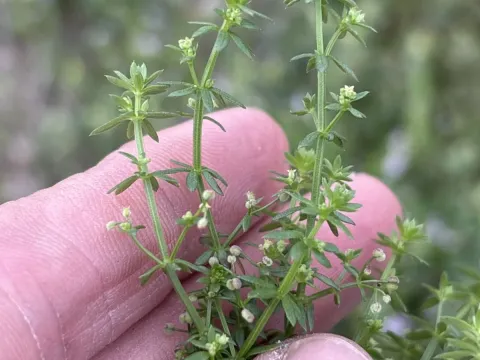
Wall bedstraw
Galium parisiense
Wall bedstraw (Galium parisiense) is an annual herb within the Rubiaceae family. While not a cultivated crop, it is a significant botanical species often encountered in wild habitats and, occasionally, as a minor weed in specific agricultural environments across Europe and the Mediterranean.
What the section contains
Wall bedstraw
This species thrives in light, sandy, and well-drained soils. It exhibits a preference for open, sun-exposed sites such as dunes, rocky outcrops, and disturbed sandy areas where competition from more vigorous, tall-growing vegetation is minimal or absent.
The distribution of Galium parisiense covers much of the Mediterranean basin and Western Europe. Its biological cycle is optimized for climates with mild, moist winters and hot, dry summers, allowing it to complete its life cycle before the onset of extreme heat stress.
Botanically, it is distinguished by thin, wiry stems and narrow leaves arranged in whorls along the stem. The plant produces delicate, greenish-white or pale purple flowers organized in loose panicles, ensuring successful reproduction through seed production in nutrient-poor environments.
From an agronomic perspective, Wall bedstraw does not possess any industrial or forage value. It is considered a negligible weed, primarily appearing in fallow lands or poorly established crop stands where soil fertility and moisture levels are low.
Like many members of the Galium genus, the plant is susceptible to various fungal pathogens, particularly powdery mildew and rust species. These fungi naturally limit the plant's spread by reducing the photosynthetic capacity of the foliage.
Insects, such as certain species of leaf beetles (Chrysomelidae), are known to graze on the foliage of bedstraw plants. However, since the biomass produced by Wall bedstraw is low, these insect populations rarely have a significant economic impact on surrounding crops.
The competitive capacity of this plant against staple crops is extremely weak. In modern high-input agricultural systems, standard agronomic practices ensure that Galium parisiense remains a secondary species, easily outcompeted by robust crop varieties.
Control measures primarily involve standard mechanical cultivation, which disrupts the shallow root system. Once the soil is prepared and the crop canopy closes, the light-dependent Wall bedstraw is typically shaded out and suppressed effectively.
Chemical control is rarely required specifically for this species. Broad-spectrum herbicides used for broad-leaved weed control are more than sufficient to eliminate any presence of Wall bedstraw, making it a non-issue in intensive production systems.