
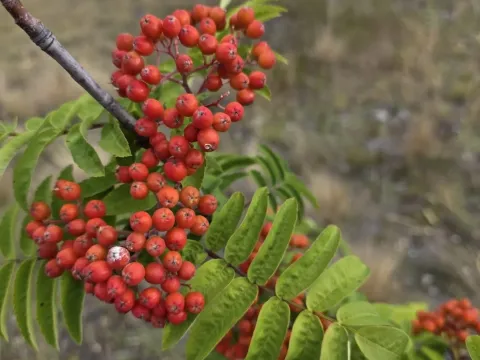
Rowan
Sorbus L.
Rowan (Sorbus L.) belongs to the Rosaceae family. Planting rowan saplings is recommended primarily in autumn during the dormancy period, or in early spring before active sap flow begins in the buds.
What the section contains
 Broad-leaved whitebeam
Sorbus latifolia (Lam.) Pers.
Broad-leaved whitebeam
Sorbus latifolia (Lam.) Pers.
 European rowan
Sorbus aucuparia L. subsp. praemorsa (Guss.) Nyman
European rowan
Sorbus aucuparia L. subsp. praemorsa (Guss.) Nyman
 Hubei rowan
Sorbus hupehensis C.K. Schneid
Hubei rowan
Sorbus hupehensis C.K. Schneid
 Japanese rowan
Sorbus commixta Hedl.
Japanese rowan
Sorbus commixta Hedl.
 Madeira rowan
Sorbus aucuparia L. subsp. maderensis (Lowe) McAll.
Madeira rowan
Sorbus aucuparia L. subsp. maderensis (Lowe) McAll.
 Pohuashan Mountain Ash
Sorbus aucuparia L. subsp. pohuashanensis (Hance) McAll.
Rowan
Sorbus aucuparia L.
Pohuashan Mountain Ash
Sorbus aucuparia L. subsp. pohuashanensis (Hance) McAll.
Rowan
Sorbus aucuparia L.
 Service tree
Sorbus domestica L.
Siberian Rowan
Sorbus aucuparia L. subsp. sibirica (Hedl.) Krylov
Service tree
Sorbus domestica L.
Siberian Rowan
Sorbus aucuparia L. subsp. sibirica (Hedl.) Krylov
 Swedish whitebeam
Sorbus hybrida L.
Swedish whitebeam
Sorbus hybrida L.
 Swedish whitebeam
Sorbus intermedia (Ehrh.) Pers.
Swedish whitebeam
Sorbus intermedia (Ehrh.) Pers.
 Umbrella whitebeam
Sorbus umbellata (Desf.) Fritsch
Umbrella whitebeam
Sorbus umbellata (Desf.) Fritsch
 Whitebeam
Sorbus aria (L.) Crantz
Whitebeam
Sorbus aria (L.) Crantz
 Wild service tree
Sorbus torminalis (L.) Crantz
Wild service tree
Sorbus torminalis (L.) Crantz
Rowan
Choose well-lit areas for establishing an orchard, as rowan is a light-loving culture. In shaded conditions, yield decreases significantly, and fruits lose their flavor profile and vitamin content.
Planting holes should be prepared in advance, filled with a fertile mixture of turf soil, humus, and mineral fertilizers. The distance between trees depends on the variety and canopy formation, typically ranging from 3 to 5 meters.
Propagation of rowan can be done both by seeds and vegetatively: grafting, layering, or root suckers. Using varietal saplings grafted onto rootstocks allows for fruits with desired characteristics to be obtained within 3–4 years.
The root system of rowan is quite plastic, allowing it to adapt to various soil types, although the crop develops best in loamy and sandy loam substrates with a neutral or slightly acidic reaction.
The crop is characterized by high winter hardiness and is capable of enduring severe climatic conditions in northern regions. It is successfully cultivated in temperate climate zones, demonstrating resistance to temperature fluctuations.
Rowan is demanding regarding soil moisture but cannot tolerate water stagnation or waterlogging. During dry periods, regular watering is necessary, especially during the phase of intensive fruit growth and the setting of fruit buds for the next season.
For normal development, the tree requires annual pruning. The procedure includes sanitary cleaning of the canopy from dead branches, as well as thinning to improve light penetration and ventilation of the internal parts of the tree.
Fertilizers are applied in stages: nitrogen fertilizers in spring to stimulate green mass growth, potassium and phosphorus in summer for fruit development, and organic matter in autumn to prepare the root system for winter.
The culture is an excellent honey plant and is often used in agroforestry to create windbreak belts, which additionally increases the environmental value of the garden plot.
The productivity of a mature rowan tree depends on varietal characteristics, agricultural background, and regional climatic conditions. On average, a healthy tree can produce 20 to 50 kilograms of fruit annually.
With intensive care and regular fertilization, yields can increase significantly. Some modern selection varieties are characterized by a high fruit load, requiring the installation of props under the branches.
Rowan fruits are widely used in the food industry. They are used to produce jams, preserves, fruit paste, liqueurs, and are also used as a vitamin supplement in confectionery products.
In the pharmaceutical industry, rowan is valued for its high content of vitamins (especially vitamin C and carotenoids), organic acids, and pectins, making it a sought-after raw material for dietary supplements and medicinal drugs.
The harvest should be stored in cool, dry rooms. Fruits can be dried, frozen, or processed, which allows them to retain their beneficial properties for a long time.
The main pests affecting rowan include the rowan moth, leafrollers, and various types of aphids. These insects damage both leaves and fruit ovaries, which significantly reduces the marketability of the crop.
Among fungal diseases, scab, rust, and moniliasis are the most common. They affect the foliage and bark, causing premature leaf fall and a decrease in the general immunity of the plant.
For disease control, it is recommended to carry out preventive spraying with fungicides in early spring before bud break and after flowering. The use of biological preparations allows for minimizing chemical load.
Pest control includes collecting and disposing of fallen leaves where larvae overwinter, as well as installing sticky bands on tree trunks during the summer period.
Timely implementation of agricultural practices, such as regular pruning and ensuring an optimal water balance, significantly increases the resistance of rowan to pathogens.
Harvesting rowan takes place in late August or September, when the fruits acquire their characteristic varietal color. The optimal time for harvesting is considered to be after the first frost if fruit bitterness is a varietal trait.
Fruits are collected by hand, carefully cutting the clusters with pruning shears or secateurs to avoid damaging the fruit buds for next year's harvest. It is not recommended to shake fruits from the tree.
Collected fruits are sorted, removing damaged specimens and debris, after which they are dried in the shade or sent immediately for processing. For long-term storage, clusters can be hung in ventilated dry rooms.
The quality of the harvest directly depends on the timeliness of the harvest. Overripe fruits become soft and lose their transportability, while unripe fruits have an increased bitterness content.
After harvesting is completed, sanitary treatment of the tree is carried out, including the removal of diseased branches and preparation of the orchard for the winter period, which is the key to stable fruiting in subsequent seasons.