
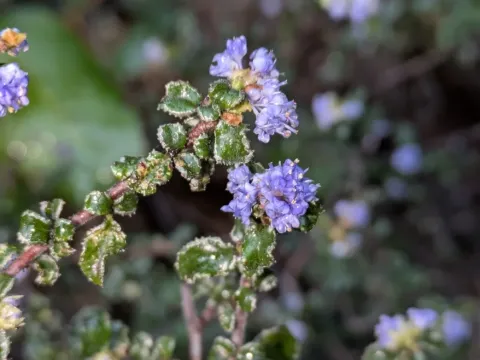
Wavyleaf ceanothus
Ceanothus foliosus
Wavyleaf ceanothus (Ceanothus foliosus) is a hardy evergreen shrub belonging to the Rhamnaceae family. Native to the coastal ranges of California, this species is highly valued in horticulture for its dense foliage and clusters of intense blue flowers that bloom in the spring.
What the section contains
Wavyleaf ceanothus
The plant requires full sun exposure to thrive and maintain its dense, compact growth habit. It is highly adapted to Mediterranean climates, where it can withstand periods of summer drought, provided it has established a deep and robust root system during the initial years of growth.
Soil requirements are critical for the survival of Ceanothus foliosus. It demands excellent drainage and performs best in well-aerated, rocky, or sandy soil types. Heavy clay soils that retain moisture should be avoided, as they frequently lead to crown and root rot, which is fatal to the plant.
Cultural practices include minimal pruning, mainly performed after flowering to maintain shape or remove damaged wood. Fertilization is generally unnecessary, as the plant is adapted to nutrient-poor soils; in fact, heavy fertilizers can reduce the plant's lifespan by causing rapid, weak growth.
Landscape applications include planting in xeriscapes, shrub borders, or as a focal point in rock gardens. Due to its drought tolerance, it is an excellent choice for water-wise gardening in appropriate USDA hardiness zones, providing year-round structure and seasonal color.
The most significant threat is Phytophthora root rot, which typically occurs in poorly drained soils. Managing irrigation and soil composition is the primary method of preventing this devastating disease, as chemical control after infection is often ineffective.
Insect pests such as aphids and scale insects are common in garden settings. These pests cluster on new growth, weakening the shrub and encouraging the growth of sooty mold. Regular monitoring and integrated pest management are recommended to keep the shrubs healthy.