
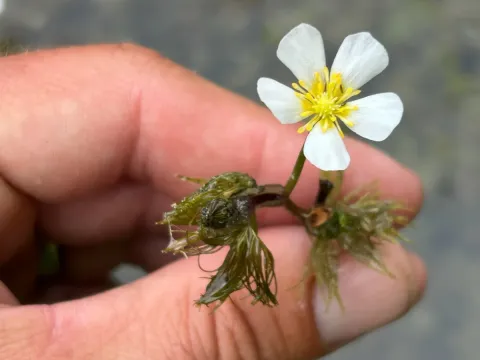
Stiff water crowfoot
Ranunculus longirostris
Stiff water crowfoot (Ranunculus longirostris) is a specialized aquatic plant belonging to the Ranunculaceae family. It is distinct from terrestrial crops, as it has evolved specifically to thrive in freshwater environments like ponds, lakes, and slow-moving streams throughout North America.
What the section contains
Stiff water crowfoot
The plant features submerged stems that are highly flexible, allowing it to withstand currents. Its leaves are finely dissected into thread-like segments, a specialized adaptation that maximizes the surface area for photosynthesis and nutrient absorption in an aquatic medium.
Climatic requirements for this species are centered around temperate zones. It thrives in environments with high water clarity, as light penetration is essential for its survival. Unlike many invasive weeds, it prefers water that is not overly enriched with nutrients, which makes it a sensitive bioindicator.
Regarding cultivation, the plant is not typically grown as a cash crop. However, in ecological restoration projects, it is encouraged for its ability to oxygenate water and provide critical nursery habitats for various aquatic organisms, including fish and macroinvertebrates.
Botanical propagation occurs both sexually through seeds, which develop after the white flowers emerge above the water surface, and vegetatively via stem fragmentation, allowing the plant to colonize new areas within a connected water system efficiently.
The primary threat to the stability of Stiff water crowfoot populations is cultural eutrophication. Nutrient runoff from agricultural lands encourages rapid algae growth, which forms dense surface mats that starve submerged vegetation of vital sunlight.
Chemical pollutants are equally dangerous. Herbicides and pesticides used in neighboring fields often enter the water table, causing significant physiological damage or death to the plant's delicate vascular system.
Competition from aggressive invasive aquatic plants, such as Eurasian watermilfoil, often results in the displacement of Ranunculus longirostris. These invaders create monocultures that outcompete native species for nutrients and space.
Hydrological alterations, such as the drainage of wetlands or severe water level fluctuations, can uproot established colonies. Maintaining stable water depths is crucial for the healthy development of this species throughout its growing season.
To preserve this species, it is recommended to implement riparian buffer strips that filter agricultural runoff and prevent sediment from entering the water body, thereby ensuring the long-term survival of native aquatic biodiversity.