
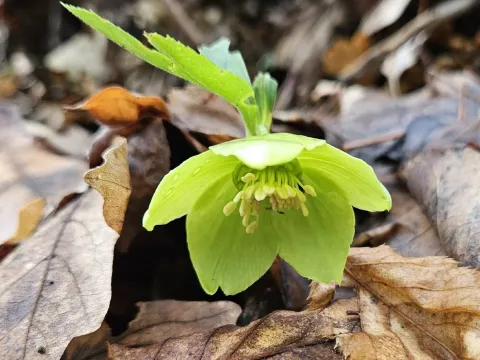
Stinking hellebore
Helleborus odorus
Stinking hellebore (Helleborus odorus) is a long-lived perennial plant belonging to the Ranunculaceae family. It is typically propagated through seeds sown immediately after maturation or by dividing established clumps.
What the section contains
Stinking hellebore
Seeds are best sown in open ground as soon as they are collected in late spring. They require a cold stratification period to break dormancy, making autumn or winter sowing effective in temperate regions.
Division of mature plants should be carried out in early spring or late autumn when the plant is not in its peak growth phase. Care must be taken to include several healthy buds in each division to ensure plant viability.
The culture exhibits a slow growth habit, and seedlings often take several years to reach the flowering stage. Patience is essential for gardeners aiming to establish large colonies from seeds.
Planting density should be managed to prevent overcrowding, allowing sufficient airflow to reach the base of the plant, which is crucial for preventing humidity-related issues in the foliage.
Native to the woodlands of Southeastern Europe, this species thrives in partial shade. It is an ideal plant for garden areas with filtered light, simulating the environment of its natural habitat under tree canopies.
The ideal soil is rich in organic matter, fertile, and well-drained. While the plant appreciates moisture, it is highly susceptible to root rot if grown in heavy or waterlogged soils, requiring excellent drainage systems.
The plant performs best in neutral to slightly alkaline soil conditions. If the soil is too acidic, amending it with lime is recommended to ensure the plant can access necessary nutrients effectively.
Stinking hellebore is notably hardy, capable of surviving significant winter frosts. However, in regions with harsh, open winters, a layer of organic mulch can protect the root system from freezing and thawing cycles.
Consistent watering is required during the establishment phase and throughout dry summer periods. It is vital to ensure that the soil remains moist but never saturated to avoid physiological stress.
Leaf spot caused by the fungus Coniothyrium hellebori is the most significant disease affecting the culture. It manifests as dark, spreading spots on the leaves, especially in humid conditions.
Root rot, caused by various soil pathogens, frequently occurs when plants are overwatered or planted in poor-draining substrates. This condition is often fatal and difficult to treat once advanced.
Aphids often target the developing flower buds during the spring growth flush. Regular monitoring and the application of insecticidal soaps are standard management practices to mitigate damage.
Slugs and snails can cause substantial damage to tender young leaves. These pests are particularly active during damp weather and can be managed using physical barriers or organic baits around the base.
Good cultural practices, such as clearing away dead foliage at the end of the season and ensuring proper spacing between plants, significantly reduce the incidence of both pests and fungal pathogens.
The collection of roots for medicinal purposes is performed after the vegetative season concludes in the autumn. The roots are excavated with care to preserve the integrity of the plant's growth points.
Post-harvest, the roots must be thoroughly cleaned of soil and debris using cold water. Excessive soaking should be avoided to prevent the leaching of water-soluble active compounds found in the tissue.
Drying is performed in well-ventilated, shaded areas at moderate temperatures not exceeding 45 degrees Celsius. Exceeding this temperature can lead to the degradation of essential phytochemicals.
Once dried, the raw material should be stored in airtight containers within a cool, dark environment. This prevents moisture absorption and maintains the quality of the harvested roots for up to two years.
In most professional agricultural contexts, the plant is valued for its ornamental contribution to shade gardens rather than commercial harvesting, with maintenance focused on pruning faded flowers.