
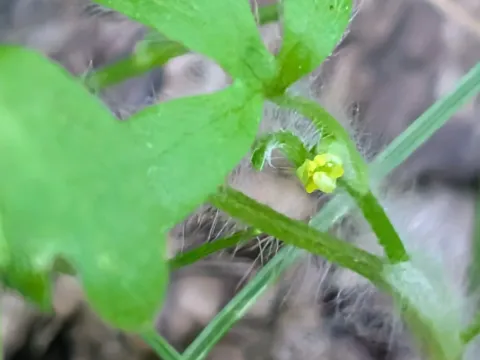
Fuzzfruit buttercup
Ranunculus hebecarpus
Fuzzfruit buttercup is an annual herb that completes its life cycle within a single growing season, primarily driven by seasonal precipitation. Seeds generally germinate during the cooler, wetter months of the year, which align with the biological readiness of the embryo.
What the section contains
Fuzzfruit buttercup
For successful cultivation, seeds require a well-prepared seedbed that is friable and free of large clods. Sowing should be carried out at a shallow depth of approximately 0.5 to 1 centimeter to ensure consistent moisture contact for the seeds while preventing premature drying.
Optimal sowing timing is critical; planting too early in the heat can lead to low emergence rates. Growers should monitor local temperature trends, aiming for consistent ranges that trigger natural dormancy breakage in the seeds.
Field-scale sowing benefits from row cultivation, which allows for better air circulation and easier access for maintenance. Seed spacing should be carefully managed to prevent inter-plant competition, which can significantly reduce the vitality of individual buttercup specimens.
Post-sowing moisture management is essential during the initial two-week period. Once the seedlings have established a root system, they become more resilient to brief dry spells, although continuous water supply remains beneficial for optimal biomass production.
This species thrives in sunny, open locations that offer protection from severe wind. While it is adaptable to various soil types, it performs best in well-drained, nutrient-rich soils that facilitate deep root development without the risk of waterlogging.
Soil pH should ideally be neutral or slightly acidic. In areas with highly alkaline or heavily clayed soils, amending the site with organic matter is recommended to improve the structure and cation exchange capacity of the growing medium.
The plant demonstrates a strong preference for cool-season growth patterns. Excessive heat during the late spring can trigger early flowering and senescence, which limits the potential for developing a full, robust vegetative structure.
Effective drainage is perhaps the most important physical requirement for this crop. Sites susceptible to ponding should be avoided, as the roots are highly sensitive to anaerobic conditions, which quickly lead to root decay and overall plant failure.
While nitrogen is needed for green growth, it should be applied cautiously. Excess fertilization can promote rapid but weak growth, making the plants more susceptible to lodging and secondary fungal infections during humid conditions.
Powdery mildew is a prevalent concern, often appearing as a white fungal dusting on the foliage. It flourishes in stagnant, humid air, making thinning and spacing essential management practices to reduce the incidence and spread of the disease.
Aphids are the primary insect pests affecting Fuzzfruit buttercup. They congregate on the undersides of leaves and at the base of flower stalks, where they suck sap and transmit viral pathogens that can cause leaf curling and plant stunting.
Root rot, associated with several soil-borne fungi, remains a major threat in fields with inadequate drainage. The presence of these pathogens often necessitates a strict crop rotation schedule to break the infection cycle in the soil.
Competition from aggressive, broad-leaved weeds can severely limit the growth of buttercup populations. Early-season manual weeding or the use of light mechanical cultivation is necessary to maintain clean stands and ensure high vigor.
Lastly, wireworms can pose a hidden threat by feeding on the root collar, particularly in fields recently converted from sod. Integrated pest management strategies, including scouting and soil testing, are vital for minimizing losses.