
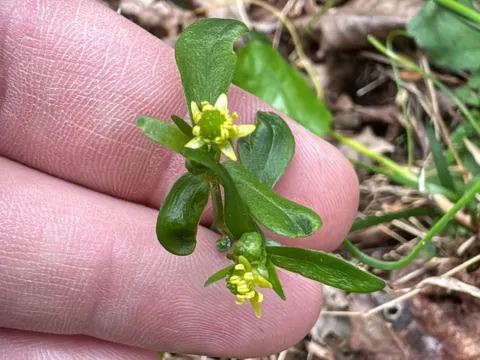
Kidney-leaf buttercup
Ranunculus abortivus
The kidney-leaf buttercup is a biennial or short-lived perennial that propagates primarily through seed germination during cool, moist spring conditions.
What the section contains
Kidney-leaf buttercup
Seeds of this species exhibit a dormancy period, allowing them to remain viable in the soil seed bank for extended durations before favorable conditions arise.
Natural dispersal typically occurs as seeds drop near the parent plant, though tillage practices often spread them across wider areas of agricultural land.
The life cycle begins with the development of a basal rosette of kidney-shaped leaves in the first year, which precedes the flowering stage in the subsequent year.
Germination is highly dependent on soil moisture levels, with peak activity occurring when spring rains follow the final thaw of the winter season.
As a member of the Ranunculaceae family, the kidney-leaf buttercup thrives in damp, shaded environments, including woodland edges and meadow ecosystems.
The plant demonstrates a preference for nutrient-rich, moist soils that maintain high humidity levels throughout the vegetative phase of its lifecycle.
While it is relatively tolerant to varying light conditions, it performs best in partial shade, where the risk of rapid soil dehydration is significantly reduced.
The species is native to North America and is well-adapted to temperate climates with distinct seasonal variations in temperature and precipitation.
Cultural management in agricultural settings involves maintaining clean field edges and employing crop rotation to disrupt the plant's natural life cycle.
Typical threats include various fungal pathogens such as downy mildew and leaf spots, which thrive in the same humid conditions favored by the buttercup.
Root rot is a significant problem when the plant occupies areas with poor drainage, often leading to total collapse of the plant in saturated soils.
Insect pests such as aphids and spider mites frequently colonize the leaves, causing chlorosis and reducing the plant's overall photosynthetic efficiency.
Some species of soil-dwelling larvae can damage the root crown, providing entry points for secondary bacterial infections that weaken the entire plant.
In managed fields, these threats often serve to naturally suppress the population, though herbicide application remains the primary method for control.