
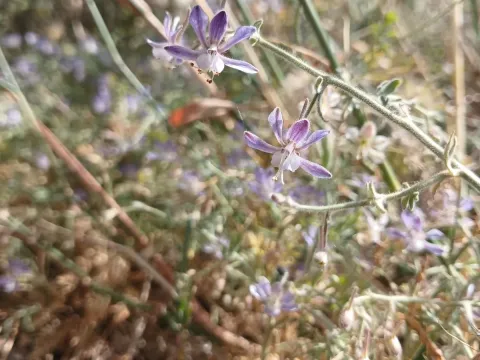
Consolida incana
Consolida incana
Consolida incana belongs to annual herbaceous plants, so its propagation is primarily carried out by seeds. Sowing in open ground is performed in early spring as soon as the soil warms up to positive temperatures.
What the section contains
Consolida incana
Late autumn sowing at the end of October is also allowed, which enables seeds to undergo natural stratification and germinate as early as possible the following spring. The optimal seed planting depth should not exceed 1–2 centimeters.
In the case of spring sowing, seedlings usually appear within 14–20 days depending on soil moisture and temperature levels. Thinning is performed after the emergence of two true leaves.
The distance between plants after thinning should be at least 15–20 centimeters to ensure proper ventilation of the bush. The crop does not tolerate transplantation well, so it is recommended to sow seeds directly in the permanent location.
To achieve earlier flowering in cold climate regions, greenhouse seedling cultivation in peat pots is practiced followed by planting in the ground. This method helps avoid trauma to the root system, which is sensitive to mechanical stress.
The plant belongs to the Ranunculaceae family and is highly demanding regarding lighting conditions. Consolida incana prefers open, sunny areas protected from strong winds that can damage tall stems.
The crop is not particularly picky about soil composition, but it develops best in light, well-drained loamy or sandy soils. Moisture stagnation in the root zone is unacceptable as it quickly leads to rot development.
The optimal pH level of the soil should be within neutral values. Excessively acidic soils require preliminary liming before sowing seeds.
During the active growth period, the plant needs moderate watering; however, during the flowering phase, watering should be reduced. Excessive nitrogen fertilizer application can trigger excessive green mass growth at the expense of inflorescence quality.
Agrotechnics include regular loosening of row spacings, which facilitates better oxygen access to the roots and prevents rapid moisture evaporation. Weed removal at early stages of growth is a mandatory measure.
The main threat to Consolida incana is powdery mildew, which arises due to dense planting and poor air circulation. The infection manifests as a white coating on the leaves, significantly reducing the plant's decorative value.
Under high humidity conditions, the root system can be affected by various types of rot, which often leads to wilting and the death of the entire bush. Strict adherence to the watering regime and timely removal of diseased specimens serve as prevention.
Among pests, the larvae of the delphinium fly pose the greatest danger, damaging buds and inflorescences. Systemic insecticides are applied during the budding period to combat them.
Aphids can also colonize young shoots, sucking out cell sap, which leads to leaf deformation. It is recommended to use biological or chemical protection agents upon detecting the first signs of colonies.
Slugs can damage young seedlings, especially in rainy weather, so it is useful to scatter barrier materials around the crops to impede their movement.