
Feather-bristle needle grass
Stipagrostis uniplumis
Description
Growing requirements
Stipagrostis uniplumis, commonly known as feather-bristle needle grass, is a perennial grass species belonging to the Poaceae family. It is native to arid regions of Southern Africa and represents a vital component of desert and semi-desert ecosystems.
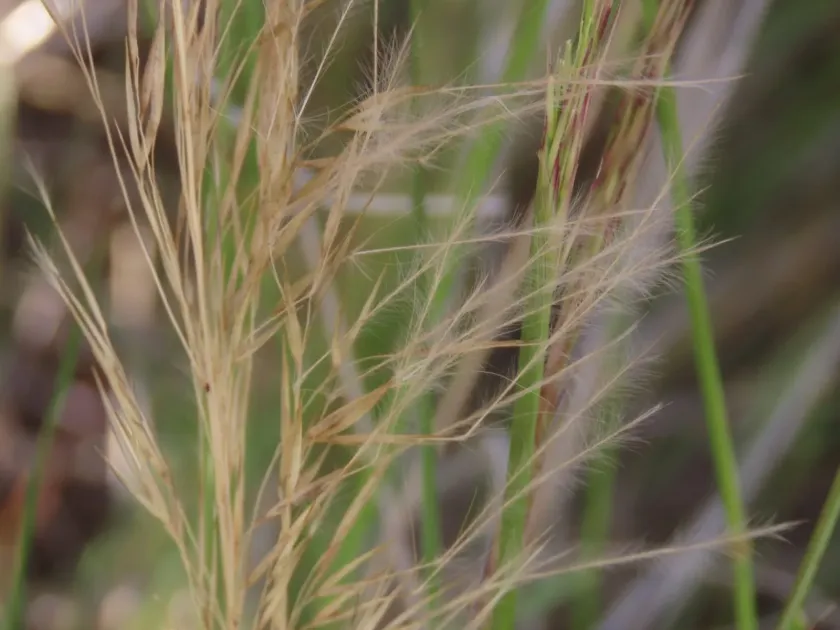
The plant exhibits a dense, tufted growth habit with narrow, hardy leaf blades and distinctive inflorescences. Its most notable botanical feature is the single feathery awn on the lemma, which aids in seed dispersal via wind, allowing the species to colonize harsh, sandy landscapes effectively.
Regarding environmental demands, this species requires high solar radiation and thrives in sandy, stony, or gravelly soils. It is remarkably drought-tolerant, capable of surviving in areas where annual rainfall is extremely low, making it an essential candidate for arid land management.
From a forage perspective, the species serves as a valuable grazing resource for livestock, particularly camels, goats, and sheep. Although the foliage can be coarse, its ability to remain green or provide dry fodder when other vegetation dies off makes it indispensable for survival in arid pastoral systems.
Furthermore, the agricultural application of this grass extends to land restoration and erosion control. Its dense root system and tufted structure make it highly effective at stabilizing shifting sands, thus protecting fertile patches and preventing the encroaching of desertification on more productive lands.
Main diseases and pests
The primary threats to Stipagrostis uniplumis are overgrazing and the destruction of the soil crust. Due to its adaptation to harsh environments, the plant is generally resistant to typical fungal diseases and pests, though it may suffer if the soil structure is severely compromised.