
Stipagrostis karelinii
Stipagrostis karelinii
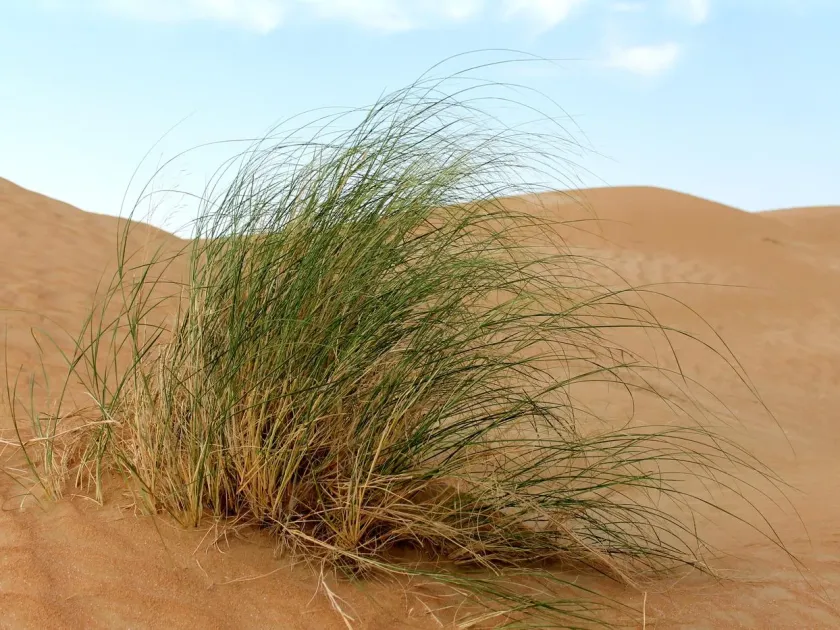
Description
Sowing dates
Stipagrostis karelinii reproduces primarily via seeds, which are adapted for dispersal by wind across open sand dunes in arid environments.
In restoration projects, sowing is typically performed in late autumn to allow the seeds to benefit from natural precipitation during the cooler months.
Successful establishment requires careful timing to match the moisture availability in the soil, which is critical for seedling survival.
Direct seeding methods are preferred to minimize disturbance to the existing sandy structure, which is vital for long-term stabilization.
The seeds exhibit dormancy, which is an evolutionary strategy to ensure germination occurs only when environmental conditions are optimal for survival.
Growing requirements
Belonging to the Poaceae family, Stipagrostis karelinii is a specialized grass species found extensively in the sandy deserts of Central Asia.
The plant thrives in nutrient-poor, loose sandy soils where its extensive root system serves to anchor the shifting substrate effectively.
It demonstrates remarkable tolerance to extreme solar radiation and high soil surface temperatures that would be fatal to most agricultural crops.
The species requires little to no additional water input once established, as it has evolved specific physiological mechanisms to conserve moisture.
It plays a key ecological role by acting as a pioneer species that stabilizes sand dunes, thus creating conditions for other vegetation to take root.
Main diseases and pests
Overgrazing poses the most significant threat to Stipagrostis karelinii populations, as cattle can easily damage the root structure and soil cover.
Although highly resilient, the plant can be susceptible to fungal diseases during unusually wet periods, which are rare in its native habitat.
Pests, particularly locusts and other grasshoppers, can periodically threaten the biomass, especially during years of high pest population density.
Human activities, including land development and off-road vehicle use, significantly contribute to the destruction of the fragile desert habitat.
Conservation of the species relies on sustainable land management and protection of desert ecosystems from intensive agricultural or industrial use.