
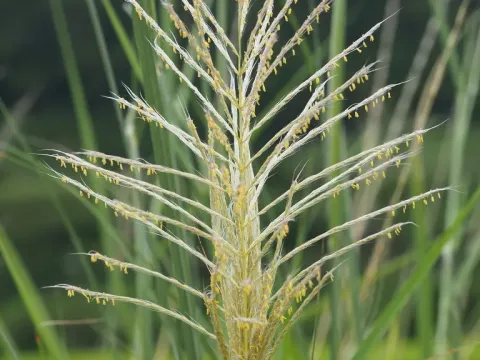
Sugarcane
Saccharum L.
Sugarcane (Saccharum L.) is a perennial grass of the Poaceae family. In commercial agriculture, it is propagated vegetatively using stem cuttings, as sexual reproduction via seeds is avoided to maintain the specific traits of high-yielding varieties.
What the section contains
 Barber sugarcane
Saccharum barberi Jeswiet
Barber sugarcane
Saccharum barberi Jeswiet
 Chinese sugarcane
Saccharum sinense Roxb.
Chinese sugarcane
Saccharum sinense Roxb.
 Robust sugarcane
Saccharum robustum E. W. Brandes & Jeswiet ex Grassl
Robust sugarcane
Saccharum robustum E. W. Brandes & Jeswiet ex Grassl
 Saccharum arundinaceum
 Retz.
Saccharum arundinaceum
Saccharum arundinaceum Retz.
 Sugarcane
Saccharum hybr.
Sugarcane
Saccharum hybr.
 Sugarcane
Saccharum officinarum L.
Sugarcane
Saccharum officinarum L.
 Wild sugarcane
Saccharum spontaneum L.
Wild sugarcane
Saccharum spontaneum L.
Sugarcane
Planting involves placing stem cuttings, known as setts, into furrows 20–40 cm deep. Each sett must have healthy buds that will emerge to form new stalks. Proper soil moisture is critical at this stage to ensure rapid and uniform sprouting.
The planting density depends on the region and the variety, typically ranging from 10,000 to 15,000 stalks per hectare. Once established, a sugarcane field can produce multiple annual harvests from the same root system, a practice known as ratoon cropping.
Originating from Southeast Asia, the crop thrives in tropical and subtropical regions. Major global producers include Brazil, India, and China, where the climate allows for a long, frost-free growing season necessary for the plant's development.
Botanically, the plant consists of robust, fibrous stalks reaching heights of 2 to 6 meters. The stalk serves as the storage organ for sucrose, while the long, linear leaves are essential for efficient photosynthesis throughout the growing period.
Sugarcane is highly sensitive to cold and requires warm temperatures for growth, ideally between +20°C and +30°C. Frost can significantly damage the stalks, leading to the inversion of sucrose and a drastic reduction in sugar quality.
Water availability is a major factor in productivity. The plant has a high water requirement, particularly during the rapid elongation phase. In regions with irregular rainfall, irrigation is vital for achieving high yields and maintaining plant health.
Deep, fertile, and well-drained soils are preferred. Sugarcane performs best in alluvial or loamy soils with a neutral pH. The soil structure must allow for deep root penetration to support the heavy biomass and efficient nutrient uptake.
Adequate fertilization, including nitrogen, phosphorus, and potassium, is necessary to support continuous growth. Regular soil testing helps determine the exact nutrient needs to replenish the depletion caused by the high biomass removal during harvest.
Abundant sunlight is crucial for high sugar content. Intense solar radiation during the ripening phase enhances the plant's ability to store sucrose, directly impacting the economic output of the plantation.
Yields of sugarcane range between 60 and 120 tonnes per hectare. As one of the world's most productive crops, it serves as a primary source for sugar, bioethanol, and various byproducts such as molasses and bagasse.
Bagasse, the fibrous residue left after crushing, is widely used as a fuel source in power plants associated with sugar mills. Additionally, it serves as raw material for the paper and construction industries, making the process highly resource-efficient.
Rapid transportation is essential because sucrose content declines quickly after harvesting due to biological degradation. Modern milling facilities operate around the clock during the harvest season to process the incoming supply efficiently.
Yield efficiency is determined by both biomass and juice quality (Brix percentage). Selection of the right variety for specific agro-climatic zones is fundamental to maximizing the sugar yield per hectare.
The economic sustainability of sugarcane farming relies on the longevity of the ratoon crops, which reduces the cost of land preparation and planting for several consecutive years following the initial establishment.
Sugarcane is susceptible to a variety of diseases, many of which are exacerbated by high humidity and warm temperatures. These pathogens can significantly impair stalks and reduce the total sugar accumulation.
- Leaf diseases: Alternaria leaf spot, Anthracnose, and Helminthosporium blight.
- Root and stalk rots: Rhizoctonia, Pythium root rot, and Sclerotinia.
- Systemic threats: Smut (Ustilago scitaminea) is a particularly destructive fungal infection.
- Pests: Root-knot nematodes are among the most harmful, weakening the root system and causing stunted growth.
Integrated Pest Management (IPM) is the standard approach to maintaining crop health. This includes the use of disease-free planting material, crop rotation, and the selection of resistant cultivars to minimize the impact of infections.
Monitoring the field for signs of pests or disease is a continuous task. Early detection allows for targeted interventions, reducing the need for broad-spectrum chemical applications and protecting the surrounding ecosystem.
Good cultural practices, such as controlling plant density and ensuring adequate drainage, are essential for disease prevention. Dense canopies can create microclimates that promote the rapid spread of fungal spores.
Harvesting is performed when the plant reaches peak maturity, typically signaled by maximum sucrose levels. Mechanized harvesters are commonly used to cut, strip, and chop the stalks into billets for quick delivery to the mill.
In many regions, pre-harvest burning is practiced to remove dry foliage and weeds, making it easier for machinery to operate and reducing the volume of waste material transported to the processing facility.
While manual harvesting is still practiced in some parts of the world, mechanical harvesting has become the industry standard in large-scale operations to increase efficiency and lower labor costs.
Logistics planning is critical for successful harvest management. Efficient coordination between the fields and the mill ensures that the crop is processed while fresh, minimizing sucrose loss and maximizing output.
After the stalks are cut, the underground root system is left undisturbed to support the growth of the next ratoon crop. Proper post-harvest care, including fertilization and weed control, is vital for the success of these future yields.