
Feather aristida
Stipagrostis pennata
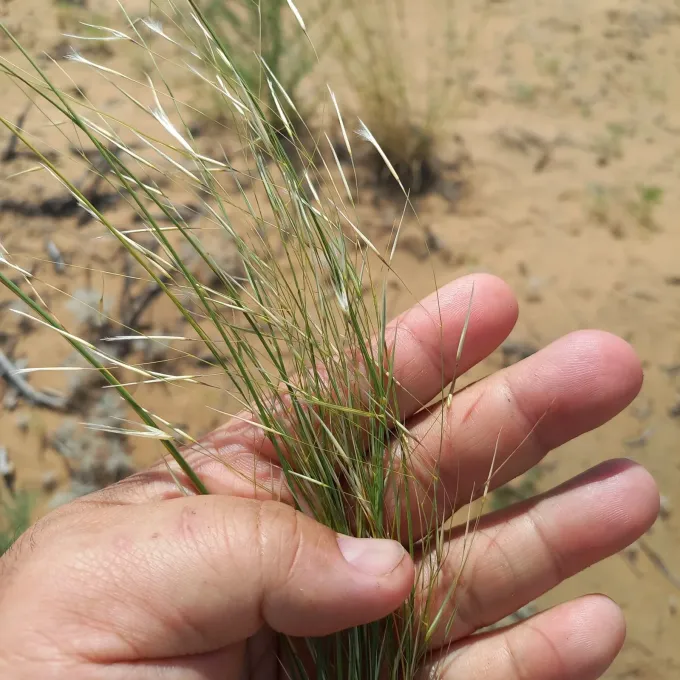
Description
Sowing dates
Sowing Feather Aristida for land reclamation purposes is typically timed to coincide with periods of high soil moisture, usually early spring or late autumn.
The seeds of this plant have high volatility due to their feathery awns, so effective sowing methods include incorporating them into the soil to prevent wind erosion.
The seeding rate is calculated to ensure the establishment of a dense sward capable of effectively holding sand particles in place and forming a protective layer.
Under natural conditions, the culture reproduces by self-seeding, successfully colonizing shifting sands when temperature regimes are favorable for germination.
A key factor in successful establishment is minimal soil disturbance, which helps maintain the natural structure of the sandy substrate and conserve moisture.
Growing requirements
Feather Aristida belongs to the Poaceae family and is a typical psammophyte, perfectly adapted to the extreme environment of shifting sand dunes.
This crop is characterized by extreme drought tolerance and the ability to withstand the high temperatures typical of the arid zones of Central Asia.
The root system is powerful, allowing the plant to extract moisture from deep sand layers and effectively anchor the substrate, thereby preventing soil erosion.
The plant prefers well-aerated sandy soils and is highly sensitive to waterlogging or high salinity, which are common in salt-affected areas.
Optimal growth requires an open, sunny location, as shading causes a sharp decline in development and reduces the overall vitality of the grass.
Yield
The agricultural use of Feather Aristida is primarily focused on phytomelioration, where the primary indicator of productivity is the rate of sand stabilization.
In natural conditions, the plant provides limited green biomass, which is utilized in spring as pasture forage for camels and sheep in desert regions.
Seed yield in specialized cultivation depends heavily on the amount of precipitation received during the vegetative and heading phases of the crop.
The biological output of organic matter is essential for developing a humus layer in the sand, which gradually improves soil fertility over time.
Intensive grazing on pastures dominated by this species is not recommended, as it destroys the protective plant cover and renews wind erosion processes.
Main diseases and pests
The main threat to the culture is overgrazing, which physically destroys the aerial parts of the plant and damages the underground root network.
During prolonged droughts, Aristida can be affected by specific desert rust fungi, which decrease photosynthetic activity and plant vigor.
Pests, such as the desert locust, can cause significant damage to crops by consuming vegetation during mass breeding cycles of the insects.
Alterations to the regional hydrological regime and a drop in groundwater levels also have a negative impact on populations in their natural habitat.
Encroachment by woody shrubs can lead to the displacement of Aristida, as it is a sun-loving plant that cannot compete with taller vegetation.
Harvesting
Harvesting of Feather Aristida seeds is carried out during full maturity, when the awns become sufficiently dry and detach easily from the parent plant.
Mechanical harvesting is complicated by the unique biology of the plant, so manual collection in natural growth areas is often the preferred method.
Collected material must be cleaned of impurities and dried immediately to prevent heating and spoilage during storage in closed containers.
Monitoring seed quality is crucial, as the feathery awns can form clumps that interfere with uniform distribution during future sowing operations.
Proper storage in a dry, cool place maintains high seed germination rates for several years, allowing for strategic reserves for land reclamation projects.