
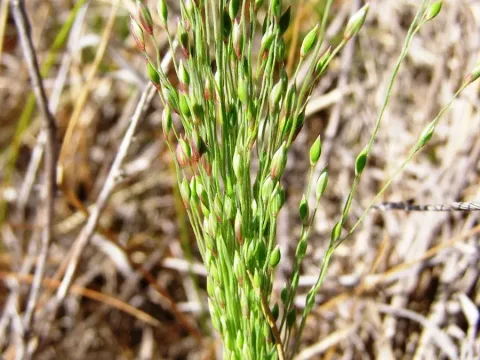
Panicum prolutum
Panicum prolutum
Panicum prolutum is a warm-season grass that requires soil temperatures to reach at least 12–15°C before planting begins. Sowing in cold soil leads to poor germination and increased risk of seedling diseases, which can significantly reduce the initial plant density.
What the section contains
Panicum prolutum
The optimal planting depth is generally 3 to 5 cm, depending on soil moisture levels and texture. Proper depth ensures that the seed reaches the moist layer of the soil while still being able to break through the surface effectively during emergence.
Seeding rates typically range from 3 to 5 million viable seeds per hectare, adjusted for local soil fertility and environmental conditions. Using precision planters helps to ensure uniform spacing, which is crucial for maximizing light interception and individual plant growth.
While standard row spacing is 15 cm, wider spacings (up to 45 cm) may be employed in arid climates to reduce plant-to-plant competition for limited moisture, or to facilitate inter-row cultivation for weed control.
Effective stand establishment is highly dependent on firming the soil around the seeds after planting. Packing the soil ensures the necessary capillary action to bring water to the germinating seeds, accelerating the uniform development of the crop.
As a member of the Poaceae family, Panicum prolutum is well-adapted to varied environments, though it performs best in regions with high solar radiation and stable summer temperatures. It thrives in conditions that would cause stress to many other cereal crops.
The crop is highly drought-tolerant, utilizing an efficient metabolism to cope with water shortages. However, it responds positively to supplemental irrigation, which can significantly increase biomass and grain yield in dry years.
Regarding soil preferences, it is adaptable to various types, including fertile chernozems and lighter sandy-loam soils. It performs best in soils with neutral to slightly alkaline pH, provided there is adequate drainage to prevent root issues.
Weed management is perhaps the most critical management factor. Because Panicum prolutum exhibits relatively slow early growth, competition from aggressive weeds can easily overwhelm the crop if not addressed through early-season mechanical or chemical control.
Nutrient management should be guided by soil testing to provide sufficient nitrogen for vegetative growth and phosphorus for robust root development, ensuring the plants are well-prepared for reproductive phases.
The potential grain yield of Panicum prolutum typically ranges between 1.5 and 3.5 metric tons per hectare, depending on the intensity of the agronomic practices and the specific local environmental conditions experienced during the growth cycle.
Optimized management strategies, including the use of high-quality certified seeds, balanced nutrition, and pest control, often push yields toward the upper end of this spectrum, providing economic viability for the grower.
Environmental stability is a hallmark of this species. Even in suboptimal years, it tends to maintain a baseline level of production, making it a reliable option for farmers seeking to mitigate risks associated with unpredictable weather patterns.
Yield components are highly sensitive to the crop's ability to fill the grain. Adequate soil moisture during the late vegetative and early reproductive stages is the most important factor in determining the final weight of the harvested crop.
Post-harvest analysis often reveals that uniform stand density is the primary driver of consistent yields across different field environments, highlighting the importance of high-quality planting operations.
Smut diseases are the most significant pathological threats to Panicum prolutum. These fungal pathogens can replace the grain with spore masses, leading to severe yield loss and decreased quality if not controlled by seed treatment.
Foliar diseases, such as leaf spot, can occur in high-humidity seasons. These diseases reduce the photosynthetic surface area of the plant, which in turn limits the amount of carbohydrates available for grain filling and maturation.
Insect pests including various grass flies and stem borers are common concerns. These pests damage the vascular tissues of the stems, causing stunted growth and, in severe cases, the death of the panicles before they reach full development.
Sucking insects, such as aphids and thrips, can cause indirect damage by transmitting viral diseases and reducing plant vigor, necessitating a strict monitoring program throughout the growing season.
- Seed disinfection with fungicides
- Crop rotation to break disease cycles
- Integrated pest management (IPM)
- Destruction of alternative host weeds
Harvesting Panicum prolutum occurs when the grain reaches physiological maturity, indicated by a characteristic color change and a moisture content drop to approximately 14–16%, ensuring safe storage conditions.
Windrowing is a preferred harvest technique for fields with uneven ripening or high weed pressure. It allows the crop to dry down naturally in the field, resulting in a more consistent quality of the harvested grain.
Direct combining is an efficient alternative for uniform, clean fields. When employing this method, harvest timing must be precise to minimize shattering losses, as the grains can be prone to detachment when fully dry.
Proper adjustment of the combine's threshing speed and concave clearance is essential. Excessive mechanical force during harvesting can lead to cracked grains, which reduces the marketability and the shelf life of the harvested product.
Post-harvest cleaning and proper aeration in storage facilities are necessary to manage moisture and prevent the development of mold, preserving the physical and nutritional integrity of the grain for its intended use.