
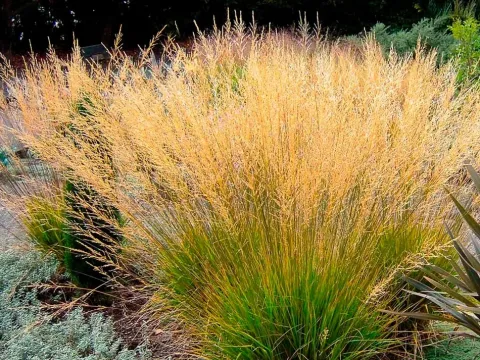
Purple moor grass
Molinia
Molinia (lat. Molinia) is a genus of perennial grasses belonging to the family Poaceae. Originating from damp habitats, wetlands, and moorlands across Eurasia, it has become a staple species for both ecological restoration and landscape design.
What the section contains
Purple moor grass
The plant grows in dense tussocks, producing slender, upright stems and narrow, linear leaves. Its inflorescence is a delicate, spike-like panicle that becomes particularly ornamental in late summer, often turning attractive shades of yellow or gold in autumn.
Molinia thrives in acidic to neutral soils that provide consistent moisture. While it is adaptable, it performs best in soils with high organic content that can retain water, yet it requires effective drainage to prevent root rot in oxygen-deprived conditions.
Regarding climate, the plant is remarkably hardy, capable of withstanding the harsh winters of temperate zones. It is a heliophilous species, meaning it requires full sun or partial shade to develop its characteristic stiff stems and vibrant foliage color.
Agronomic management is generally low-intensity. The plant requires minimal fertilization; excessive nitrogen levels are detrimental, as they cause the stems to grow too rapidly, become weak, and collapse under their own weight during the late season.
One of the primary benefits of cultivating Molinia is its inherent resistance to most common agricultural diseases. It is rarely affected by rusts or blights, provided that the planting density allows for sufficient air circulation throughout the foliage.
Pest issues are minimal. Occasionally, generalist pests such as aphids might colonize the plant, but these occurrences are usually sporadic and rarely warrant the use of chemical pesticides in well-maintained, healthy stands.
Environmental stress, specifically prolonged drought during the peak growing season, is the most common cause of poor performance. Water deficiency leads to a rapid loss of turgor and a premature decline in the plant's decorative value.
Proper seasonal sanitation is essential for phytosanitary control. Removing dead biomass in late winter or early spring is the most effective way to prevent the buildup of fungal spores and provide space for new, healthy growth to emerge.
Overcrowding is a significant threat to long-term plant vigor. When individual tussocks are planted too closely, the center of the clump can become prone to decay due to a lack of sunlight and air, necessitating careful spacing during establishment.