
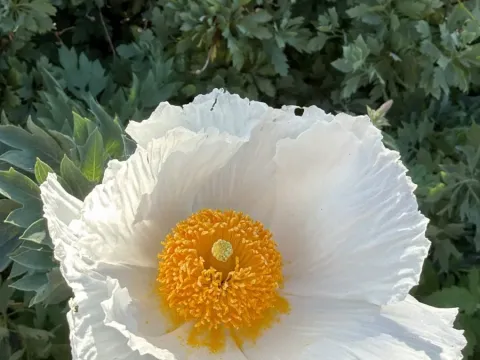
Matilija poppy
Romneya coulteri
Matilija poppy (Romneya coulteri) is a notable perennial belonging to the Papaveraceae family. Native to the semi-arid regions of Southern California and Mexico, it is well-adapted to habitats characterized by intense solar radiation and minimal rainfall.
What the section contains
Matilija poppy
The plant requires full sun exposure and extremely well-drained soil to thrive. It is notably intolerant of wet winter conditions, which can lead to root rot; therefore, planting on slopes or in raised beds with sandy or gravelly substrate is highly recommended.
Botanically, it is a robust semi-shrub that spreads via underground rhizomes. It produces some of the largest flowers among the poppy family, which are highly valued for their delicate, crepe-paper-like petals and distinctive fragrance.
Climatic requirements involve a long growing season with high temperatures. While it exhibits strong drought tolerance once established, initial irrigation is necessary for root development, provided that the water drains away from the crown immediately.
Cultivation practices suggest avoiding root disturbance at all costs. The plant possesses a taproot system that reacts poorly to transplanting; therefore, it should be established from container-grown stock directly into its permanent location.
Fungal diseases related to moisture excess remain the primary threat to this culture. Phytophthora and other soil-borne pathogens can devastate the root system if the planting site lacks proper drainage.
Pests are generally not a significant issue for established specimens, but aphids may congregate on young, succulent shoot tips during the spring. Monitoring is essential to ensure the vitality of the new growth.
Powdery mildew may appear under conditions of high humidity and poor air circulation. Proper spacing between plants is a preventive measure to maintain airflow and reduce the incidence of foliar infections.
Inappropriate soil chemistry, particularly excessive acidity, can limit nutrient uptake and weaken the plant's natural resistance to environmental stressors. Maintaining a neutral to slightly alkaline soil pH is preferable.
Sanitation is critical; removing debris and dead foliage around the base helps prevent the buildup of pathogens that thrive in decaying organic matter during the dormant season.