
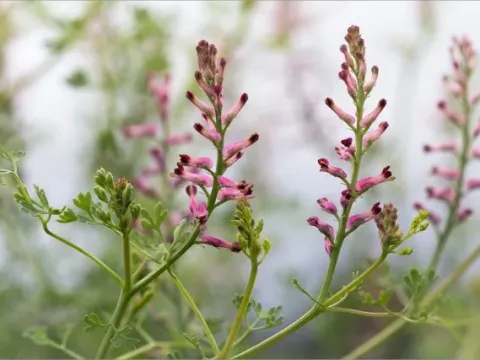
Mauritanian fumitory
Fumaria maurorum
The Mauritanian fumitory (Fumaria maurorum) is a member of the Papaveraceae family. It is an annual herbaceous plant characterized by delicate, feathery foliage and small, tubular flowers that bloom in terminal racemes.
What the section contains
Mauritanian fumitory
Originating from Mediterranean regions, this plant is well-adapted to environments with warm, dry summers. It thrives in open field conditions where direct sunlight is abundant throughout the growth cycle.
For optimal growth, it requires well-drained, fertile soil with a neutral to slightly alkaline pH. Compact or waterlogged soils are unsuitable as they impede root development and promote moisture-related stress.
Agronomic management focuses on moisture control during the germination stage. While the plant exhibits drought tolerance once established, consistent soil moisture during the vegetative phase improves biomass quality.
This species is valued in the pharmaceutical industry due to its secondary metabolites, including isoquinoline alkaloids. Cultivation is focused on maximizing the yield of foliage and flowering tops for herbal extraction purposes.
Fungal pathogens such as powdery mildew represent a major risk, particularly in high-humidity conditions. Proper spacing between rows is essential to facilitate air circulation and minimize infection risks.
Aphids are the primary insect pests affecting the crop, as they aggregate on the soft tissue of flower buds. Infestations lead to stunted growth and reduced yields, necessitating timely monitoring.
Root rot, often caused by Pythium or Rhizoctonia species, occurs when soil drainage is insufficient. Ensuring field leveling and proper irrigation scheduling helps prevent these soil-borne diseases.
Competition from annual weeds is a critical threat during the early seedling stage. Weed control should be performed mechanically to avoid soil compaction and damage to the shallow root system.
Integrated Pest Management (IPM) practices are highly recommended to protect the quality of the raw material. This includes rotating crops with non-related species to break the life cycles of specific pests and pathogens.