
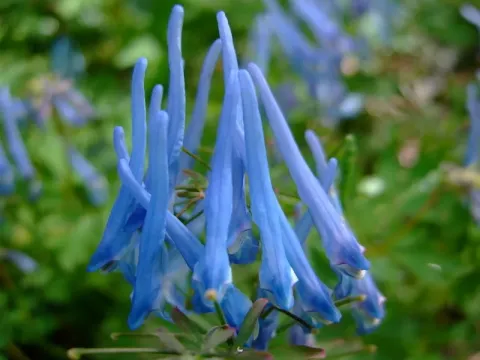
Corydalis
Corydalis DC.
Corydalis is a large genus of the Papaveraceae family, consisting of herbaceous plants known for their distinctive spurred flowers. Many species are spring ephemerals, emerging early in the season to utilize light before the forest canopy closes.
What the section contains
 Corydalis elata
 Bureau & Franch.
Corydalis elata
Corydalis elata Bureau & Franch.
 Corydalis flexuosa
 Franch.
Corydalis flexuosa
Corydalis flexuosa Franch.
 Corydalis moorcroftiana hybrid
Corydalis moorcroftiana x C. wilsonii
Corydalis shimienensis
Corydalis shimienensis C. Y. Wu & Z. Y. Su
Corydalis moorcroftiana hybrid
Corydalis moorcroftiana x C. wilsonii
Corydalis shimienensis
Corydalis shimienensis C. Y. Wu & Z. Y. Su
 Corydalis wilsonii
 N. E. Br.
Corydalis wilsonii
Corydalis wilsonii N. E. Br.
 Fumewort
Corydalis solida (L.) Clairv.
Fumewort
Corydalis solida (L.) Clairv.
 Hybrids of Corydalis elata and Corydalis flexuosa
Hybrids between Corydalis elata and Corydalis flexuosa
Hybrids of Corydalis elata and Corydalis flexuosa
Hybrids between Corydalis elata and Corydalis flexuosa
 Moorcroft's Corydalis
Corydalis moorcroftiana Wall. ex Hook. f. & Thomson
Moorcroft's Corydalis
Corydalis moorcroftiana Wall. ex Hook. f. & Thomson
Corydalis
The cultivation of Corydalis requires sites with dappled shade or partial light. The soil should be well-drained, rich in organic matter, and moisture-retentive, mimicking the conditions of forest floors where they naturally proliferate.
Proper moisture levels are critical during the early growing season. Once flowering finishes and the foliage begins to yellow, the plants enter a period of summer dormancy, during which they prefer drier conditions to prevent tuber rot.
In terms of climate, Corydalis species are exceptionally cold-hardy, thriving in temperate zones where they can experience distinct seasonal shifts. They do not require complex fertilization but benefit from a light mulch of leaf mold or compost.
Host plants are widely used in rock gardens and woodland landscapes. Beyond aesthetics, some species are investigated in botanical medicine for their alkaloid content, which displays analgesic and calming properties.
Fungal pathogens such as mildew and soft rot represent the most common threats to the health of Corydalis. These issues are often exacerbated by poor air circulation or planting in heavy, waterlogged clay soils.
Slugs and snails pose a significant risk to the foliage during the spring growth flush. Implementing natural barriers or using bait traps around the base of the plants is essential for maintaining aesthetic quality.
Rodents, particularly voles, may target the tuberous roots during the dormant season. Protecting the planting area with wire mesh is a standard preventative measure in areas with high pest activity.
Root rot is primarily linked to cultural errors rather than infectious agents. Ensuring that the site has a slight slope or improved drainage layer significantly reduces the risk of plant loss during wet summers.
Integrated pest management strategies focusing on early detection and physical barriers allow gardeners to cultivate these beautiful plants without relying heavily on chemical pesticides, ensuring a healthy garden ecosystem.