
Agalinis obtusifolia
Agalinis obtusifolia
Description
Growing requirements
Agalinis obtusifolia, commonly known in the scientific community, is a hemiparasitic plant species belonging to the Orobanchaceae family. Unlike obligate parasites, it maintains photosynthetic capabilities but significantly improves its vigor and reproductive success by attaching to the root systems of various herbaceous hosts via haustoria.
The native range of this species is primarily concentrated in the southeastern and central regions of the United States. It naturally colonizes specific habitats, including open pine savannas, moist prairies, and sandy edges of wetlands. The plant requires environments that support host diversity to optimize its nutrient uptake strategy.
Regarding soil and climate, the plant thrives in acidic to neutral sandy soils with good drainage properties. It is a heliophilous species, meaning it requires abundant sunlight throughout the growing season. The plant's distribution is highly sensitive to land management practices, such as prescribed burning, which helps clear competing vegetation and favors its germination.
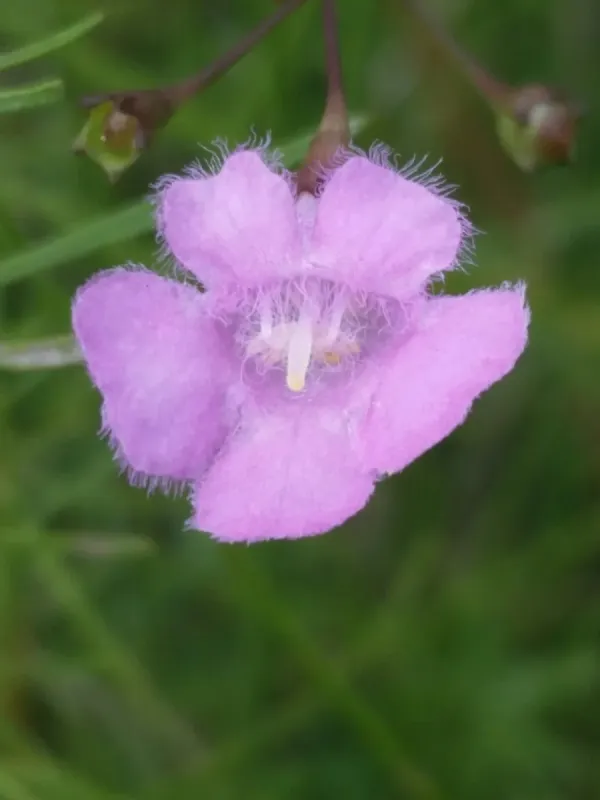
Botanically, it presents as an annual herb with slender, branching stems and opposite linear leaves. Its most distinctive feature is the pink-to-purple trumpet-shaped corolla, which blooms in late summer to autumn. The plant's root system is delicate and specialized for penetrating the roots of nearby grasses and other plants to absorb water and minerals.
While not a traditional food or fiber crop, Agalinis obtusifolia serves a crucial role in ecological conservation and restoration projects. It is highly valued in native landscaping and ecosystem biodiversity studies, where it helps maintain the balance of indigenous floral communities in preserved prairie environments.