
Agalinis setacea
Agalinis setacea
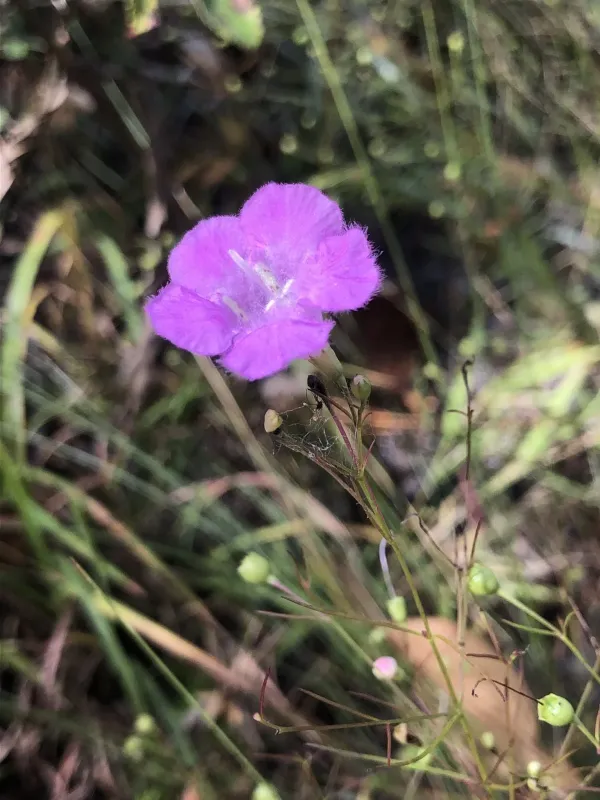
Description
Growing requirements
Agalinis setacea, commonly known as threadleaf gerardia, is a herbaceous annual plant belonging to the Orobanchaceae family. Unlike typical crops, this species is a hemiparasite, meaning it produces its own energy through photosynthesis while simultaneously deriving water and nutrients from the roots of neighboring plants via haustoria.
The native distribution of Agalinis setacea is primarily restricted to North America. It thrives in open, sunny environments with sandy or gritty soil substrates. It is frequently observed in dry prairies, open pine woodlands, and disturbed areas where the plant can maintain access to light and suitable hosts.
Botanically, the plant is characterized by slender, wire-like stems and narrow, setaceous leaves. Its root system is specialized, featuring structures that penetrate the root tissues of host species. This unique adaptation allows the plant to survive in nutrient-poor soils where competition for resources is intense.
Regarding climatic and soil requirements, Agalinis setacea demands high levels of solar radiation. It is not adapted to shaded habitats and performs best in well-drained soils. Consistent moisture is necessary during the early stages of development, but the plant is resilient to periodic dry conditions.
While not a traditional agricultural crop, understanding its ecological role is essential for conservation and grassland management. Successful growth requires the presence of compatible host plants, which act as a vital source of mineral supply for the development of its populations.
Main diseases and pests
The primary threats to Agalinis setacea populations involve habitat fragmentation and the loss of natural open landscapes. The encroachment of invasive, non-native plant species can easily outcompete this hemiparasite for sunlight and space.
Pathological risks are often associated with soil-borne fungi that affect both the parasite and its host plants. Root rot diseases can become problematic in soils with poor drainage, potentially leading to the decline of local populations within a habitat.