
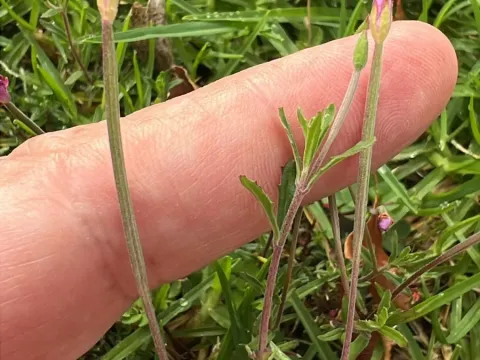
Billardieri willowherb
Epilobium billardieranum
Epilobium billardieranum is a perennial herb that is typically sown in early spring, once the soil has sufficiently warmed to support germination.
What the section contains
Billardieri willowherb
Seeds should be planted at a shallow depth of approximately 1 to 2 centimeters to ensure adequate light exposure, which is crucial for successful emergence.
The optimal time for field establishment is April, taking advantage of residual winter moisture and rising ambient temperatures for rapid initial growth.
For nursery production, seeds can be started indoors in late winter to produce vigorous transplants that can be moved to the field in late spring.
Careful attention to row spacing, typically between 50 and 60 centimeters, is essential to provide plants with sufficient space and ensure good air circulation.
This species thrives in sunny environments but exhibits sufficient plasticity to tolerate partial shade, reflecting its natural forest-edge habitat.
Well-drained, loamy or sandy soils with a near-neutral pH are ideal for promoting healthy root development and avoiding water-logging stress.
The plant is noted for its adaptability to a range of temperate climates, showing robust resistance to seasonal temperature fluctuations throughout the year.
Consistent irrigation is vital during periods of drought, particularly during the vegetative phase and the peak of the flowering cycle to maximize yields.
While relatively low-maintenance, the crop benefits significantly from balanced organic amendments that support microbial activity and soil structure.
Crop productivity is heavily dependent on soil quality and the implementation of effective weed management strategies to reduce nutrient competition.
Under favorable commercial growing conditions, Epilobium billardieranum can provide substantial yields of high-quality biomass over several consecutive seasons.
Seed production requires specialized handling, and focusing on high-vigor varieties can lead to significantly improved output for nursery or agricultural use.
A well-managed plantation can remain productive for up to five or seven years before requiring renovation or replanting efforts to maintain yields.
- High chemical potential of leaf biomass for herbal extracts
- Excellent long-term viability of perennial root systems
- Stable output levels throughout the established crop cycle
The primary threats to healthy crops include fungal pathogens that proliferate in excessively humid environments, often causing leaf spot and rot.
Insect pests such as aphids and various larvae can damage succulent young foliage, necessitating timely monitoring and integrated pest management practices.
Root rot remains a concern in poorly drained fields, highlighting the importance of site selection and proper soil preparation prior to planting.
Weed encroachment is a significant factor in yield reduction, requiring mechanical cultivation between rows to ensure the crop maintains its competitive edge.
Proactive prevention, including clearing crop debris after harvest, helps to break disease cycles and maintains the long-term health of the field.
The harvest period is ideally timed to coincide with peak flowering, as this ensures the highest concentrations of secondary metabolites within the tissues.
Mechanical harvesting is performed at a specific height of 10–15 centimeters above the ground to preserve the crown and stimulate regrowth for subsequent cuts.
Rapid post-harvest transport and drying are essential to prevent quality loss caused by heat build-up and oxidation of the fresh plant matter.
Seed harvesting should be conducted with precision once the capsules demonstrate uniform browning to prevent shatter loss in the field.
Post-harvest management involves careful cleaning and the potential application of mild nutrient top-dressing to prepare the plant for winter dormancy.