
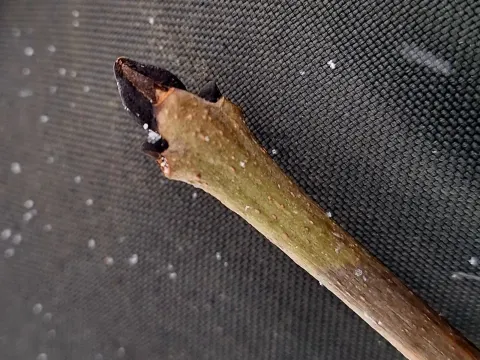
Ash
Fraxinus L.
The ash tree (Fraxinus L.) belongs to the Oleaceae family. In forestry practice, ash seeds are usually sown in the autumn immediately after harvest, as they require a long period of stratification.
What the section contains
 Black ash
Fraxinus nigra Marshall
Black ash
Fraxinus nigra Marshall
 European ash
Fraxinus excelsior L.
European ash
Fraxinus excelsior L.
 Green ash
Fraxinus pennsylvanica Marsh.
Green ash
Fraxinus pennsylvanica Marsh.
 Gregg's ash
Fraxinus greggii A. Gray
Hybrid Black Ash
Fraxinus nigra Marsh x Fraxinus mandshurica Rupr
Gregg's ash
Fraxinus greggii A. Gray
Hybrid Black Ash
Fraxinus nigra Marsh x Fraxinus mandshurica Rupr
 Manchurian ash
Fraxinus mandshurica Rupr.
Manchurian ash
Fraxinus mandshurica Rupr.
 Manna ash
Fraxinus ornus L.
Manna ash
Fraxinus ornus L.
 Narrow-leaved ash
Fraxinus angustifolia Vahl
Narrow-leaved ash
Fraxinus angustifolia Vahl
 Oregon ash
Fraxinus latifolia Benth.
Syrian narrow-leaved ash
Fraxinus angustifolia Vahl subsp. syriaca (Boiss.) Yalt.
Oregon ash
Fraxinus latifolia Benth.
Syrian narrow-leaved ash
Fraxinus angustifolia Vahl subsp. syriaca (Boiss.) Yalt.
 Uhde's ash
Fraxinus uhdei (Wenz.) Lingelsh.
Uhde's ash
Fraxinus uhdei (Wenz.) Lingelsh.
 White ash
Fraxinus americana L.
White ash
Fraxinus americana L.
Ash
If sowing is planned for the spring, the seeds must undergo cold stratification for 4–6 months at temperatures between 0 and +5°C to break the deep embryo dormancy.
The planting depth is typically 3–5 cm, depending on the soil type. An optimal planting scheme in nurseries involves maintaining row spacing of up to 20–30 cm.
Ash seedlings are sensitive to late spring frosts, so planting sites are chosen with consideration of micro-relief, avoiding lowlands where cold air accumulates.
Laboratory germination rates can vary, so it is recommended to perform a viability test on the seed material before planting it in the soil.
Ash is a species with high demands on soil fertility. The tree reaches its best development on deep, fresh, sufficiently moist loams and sandy loams with high humus content.
The crop reacts extremely negatively to heavy waterlogging and prolonged moisture stagnation. The optimal pH level for active growth ranges between 6.5 and 7.5.
The tree shows moderate shade tolerance in its juvenile stage; however, for the formation of a high-quality trunk and full growth potential, it requires good lighting in the future.
Climate requirements depend on the specific species, but in general, the common ash is frost-hardy and can withstand significant temperature drops during the winter period.
In agronomic practice, it is crucial to perform regular inter-row cultivation and weed control during the first years of the seedlings' life to ensure a competitive advantage.
The commercial use of ash is focused on obtaining high-quality lumber, which is valued for its hardness, strength, and beautiful grain pattern.
The productivity of stands is estimated by the volume of wood biomass per hectare. The period to reach commercial maturity ranges from 60 to 80 years, depending on growing conditions.
The wood is widely used in furniture production, manufacturing sports equipment, tool handles, and interior elements that require high impact resistance.
Besides timber, the ash is valued as a valuable agroforestry species, contributing to bank stabilization and the creation of windbreaks in agricultural regions.
Ash biomass is also utilized in urban landscaping due to its ability to effectively clean the air and its high decorative value of the canopy in summer and autumn.
One of the most serious biological threats to modern ash stands is the emerald ash borer, which is capable of destroying entire populations of trees in a region.
Fungal diseases, such as ash dieback (Hymenoscyphus fraxineus), cause mass wilting of branches and the death of even mature, healthy specimens.
Pests like the ash bark beetle can cause significant damage to weakened trees by attacking the cambium and the conductive tissues of the trunk.
Preventive measures include constant monitoring of forest stand conditions, sanitary felling, and timely removal of infected specimens to prevent widespread epidemics.
Using pathogen-resistant forms and selective breeding varieties is currently the most reliable way to preserve the culture in forestry.