
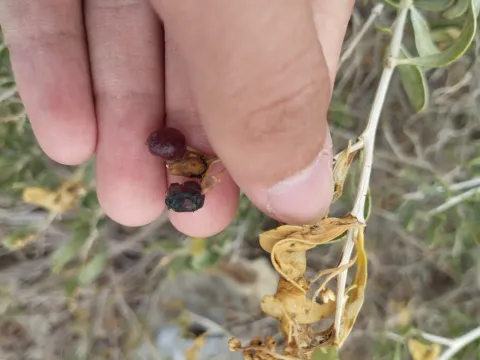
Nitraria schoberi
Nitraria schoberi
The propagation of Nitraria schoberi is primarily achieved through seeds or vegetative methods, specifically using layered branches. Seeds often require stratification to break dormancy and ensure consistent germination in saline environments.
What the section contains
Nitraria schoberi
The optimal sowing time is early spring when soil moisture is preserved after the snowmelt. This allows the seedlings to establish a strong root system before the onset of the harsh, dry summer temperatures characteristic of arid regions.
Seeds are sown at a depth of 2-3 centimeters to ensure proper contact with the soil. While the plant is inherently resilient, it is crucial to protect the seedlings from invasive weeds during the first months of growth to ensure successful establishment.
Vegetative propagation via cuttings taken during the dormant season is also a reliable method. Cuttings are planted in specialized trenches, which promotes high survival rates and rapid expansion of the root network in sandy substrates.
The planting density is determined by the intended purpose: for soil stabilization and wind erosion prevention, the shrubs are planted in dense rows, creating effective barriers against moving dunes and dust storms.
Nitraria schoberi, a member of the Nitrariaceae family, is a classic halophyte, genetically adapted to survive in highly saline and alkaline soils. It thrives in extreme environments where most common crops fail completely.
The plant exhibits exceptional drought and salt tolerance, allowing it to dominate saline marshes, desert landscapes, and salt lake shores. It manages osmotic stress by accumulating salts within its tissues, effectively balancing internal chemistry.
The ideal temperature range for active growth is between 20 and 35 degrees Celsius. The plant is highly resilient to significant diurnal temperature variations, which are typical of the deserts in Central Asia and the Caucasus.
Sunlight exposure is a critical requirement for Nitraria schoberi; it is an obligate heliophyte. Any form of shading or competition for light from taller vegetation results in reduced vitality, stunted growth, and eventual plant death.
Soils must have good aeration, even when they are heavily saturated with salts. The plant improves the structure of sandy soils over time by accumulating organic matter in the root zone, facilitating a gradual transition to more productive ground.
The biomass productivity of Nitraria schoberi is directly dependent on moisture availability during the growing season. In years with sufficient precipitation, the dry weight yield of the aerial parts can reach several tons per hectare.
The berries of this shrub are highly valued for their nutritional composition, being rich in sugars and bioactive compounds. The harvest of these fruits typically occurs in late summer once they reach full physiological maturity.
Young shoots and leaves are suitable as supplementary fodder for camels and small ruminants in regions where conventional feed sources are scarce. Utilizing the shrub for grazing allows for the productive management of marginal lands.
Peak yield is typically observed from the 5th to the 7th year of the shrub's life. During this period, the plant reaches its maximum biological efficiency, providing consistent harvests of both berries and foliage.
Interest from the food industry is growing due to the unique biochemical profile of the berries, which makes them an excellent candidate for inclusion in specialized health-food products and dietary supplements.
The primary pests affecting Nitraria schoberi include locusts, which can cause significant damage to the foliage. While massive infestations can temporarily stunt growth, the plant's natural regeneration capacity usually allows it to recover effectively.
Fungal infections are rare, as the plant's tissues contain specific alkaloids that act as natural antiseptics. However, waterlogging can be hazardous, leading to root rot when excessive moisture causes oxygen starvation in the soil.
Anthropogenic impact and overgrazing represent the greatest threats to young stands. Mechanical damage to the stems and branches provides entry points for pathogens and weakens the structural integrity of the plant.
- Root system damage caused by desert rodents.
- Soil erosion that exposes roots to excessive heat.
- Competition from invasive weeds during climate-induced changes.
Protection of these stands is generally achieved through non-chemical, preventative measures, as the large-scale application of pesticides in desert ecosystems is economically impractical and ecologically risky.
Harvesting the berries of Nitraria schoberi is a labor-intensive manual process due to the complex, often thorny morphology of the shrub. Harvesters must carefully select only fully ripe berries to ensure top-quality production.
When harvesting vegetation for fodder, selective pruning is employed. It is essential to leave enough healthy branches to ensure the plant's survival and promote rapid regeneration for the following growing season.
Once harvested, the berries require immediate processing to prevent fermentation. Because of their high sugar content, they are highly perishable, making freezing or dehydration the preferred methods for preserving the yield.
The use of appropriate protective gear and pruning tools is essential to minimize injuries to the harvester and to prevent unnecessary mechanical damage to the shrub, which is critical for its longevity.
Transportation of the harvest requires well-ventilated containers to ensure continuous airflow. Poor ventilation during transit can lead to rapid berry spoilage, resulting in significant loss of commercial and nutritional value.