
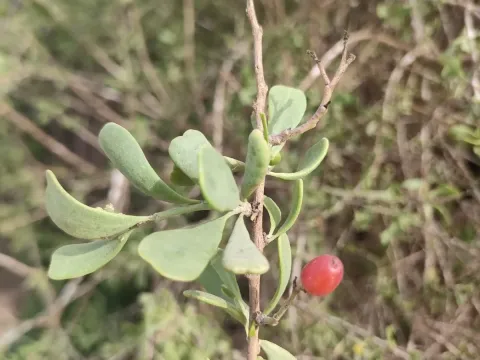
Nitraria retusa
Nitraria retusa
Nitraria retusa is a hardy evergreen shrub belonging to the Nitrariaceae family. It is recognized globally as a highly efficient halophyte, capable of thriving in saline environments and arid conditions that are typically unsuitable for traditional crops.
What the section contains
Nitraria retusa
Originating from the desert regions of North Africa and Western Asia, this plant has adapted to survive extreme heat, high salt concentrations, and limited water availability. Its natural habitat includes sandy dunes and salt marshes, where it plays a critical ecological role.
The botanical structure of the plant features succulent, fleshy leaves that serve as water storage organs. This adaptation allows the shrub to withstand prolonged periods of drought while maintaining its structural integrity and metabolic processes.
Optimal growth requires full sun exposure and well-drained soil types. While it tolerates high soil salinity, it performs best in sandy or silty soils where moisture can be trapped deep within the root zone, supporting its massive subterranean development.
Cultivation practices involve selecting drought-resistant varieties and ensuring initial protection from intense grazing. Once the root system is well-established, the shrub becomes largely self-sustaining, requiring very little intervention or supplemental irrigation.
The fruit of Nitraria retusa consists of small, edible, fleshy drupes that turn a vibrant red or dark purple upon maturation. These berries are highly valued for their sweet and tangy flavor, often consumed fresh or preserved by local populations.
Harvesting is typically performed by manual collection during the peak ripening season in late summer. Careful handling is necessary to maintain fruit quality, as the berries are delicate and contain significant nutritional value, including vitamins and minerals.
Beyond human consumption, the plant serves as a vital forage resource for livestock such as camels and goats. Its foliage provides necessary nutritional elements in desert areas, where traditional fodder crops often cannot survive or produce yield.
In agriculture, the primary utilization of this plant is land reclamation and soil stabilization. By creating dense thickets, the shrub effectively anchors shifting sands and helps mitigate soil erosion in vulnerable, degraded environments.
Future agricultural applications are exploring the potential for industrial extraction of secondary metabolites from the berries and leaves. These compounds have potential in the pharmaceutical and nutraceutical industries due to their high antioxidant concentrations.