
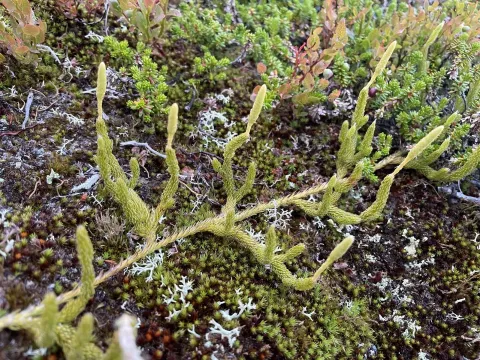
Northern firmoss
Lycopodium lagopus
Northern firmoss (Lycopodium lagopus) is a perennial spore-bearing plant belonging to the Lycopodiaceae family. It is widely distributed across the northern regions of the Northern Hemisphere, where it thrives in coniferous forests and peaty soils.
What the section contains
Northern firmoss
The plant is characterized by its creeping horizontal stems that root into the substrate at intervals. The vertical branches are covered in dense, needle-like leaves, providing a distinct appearance that helps the plant survive in cold climates.
Regarding cultivation requirements, the species demands highly acidic, moist, and well-drained soil. It is extremely sensitive to changes in atmospheric humidity and requires stable microclimatic conditions to sustain its slow growth rate.
The agronomy of this species is complex; because the plant depends on specific soil mycorrhizal fungi for spore germination, it is currently impossible to cultivate it on a commercial scale through traditional seeding methods.
Its primary economic use is the harvesting of spores, known globally as lycopodium powder. This substance is highly valued in pharmaceutical industries as a dusting powder and in metal foundries for the precise casting of small parts.
The main threats to the species involve habitat loss due to deforestation, mining, and landscape development. As a slow-growing plant, it cannot easily recolonize disturbed areas after mechanical damage.
Fungal infections can occur if the local ventilation is insufficient, leading to stem rot. Prevention relies on maintaining the natural balance of the ecosystem and avoiding waterlogging of the soil surface.
While few pests target this plant due to the presence of secondary metabolites and alkaloids in its tissues, environmental pollution and climate change pose a greater threat by altering the delicate soil chemistry.
Soil compaction represents a severe risk to the population. When the ground is trampled, it destroys the surface root system and the symbiotic fungal network, which is essential for the survival of the firmoss colonies.
Preservation strategies include strict regulation of harvesting and the protection of areas where the species is known to occur. Sustainable practices are necessary to ensure the plant continues to thrive in its natural environment.
The harvest is restricted to the sporulating cones that develop at the tips of the vertical branches. The timing of the harvest is critical and must coincide with the yellowing of the cones before the spores are released.
The collected cones are dried carefully in shaded, well-ventilated conditions. Once dry, the spores are separated from the plant material using fine-mesh sieves to ensure a high-purity final product.
Quality control during harvest focuses on moisture prevention. Damp spores lose their unique hydrophobic properties and tend to clump together, making them unsuitable for pharmaceutical or industrial applications.
Storage requires cool, dry conditions away from light to maintain the viability and physical consistency of the powder. Improper storage can lead to the degradation of the organic matter within the spores.
Commercial harvesting is usually conducted as a wildcrafting activity. Producers must implement rotational harvesting schedules to allow the colonies sufficient time to recover their reproductive capacity between harvests.