
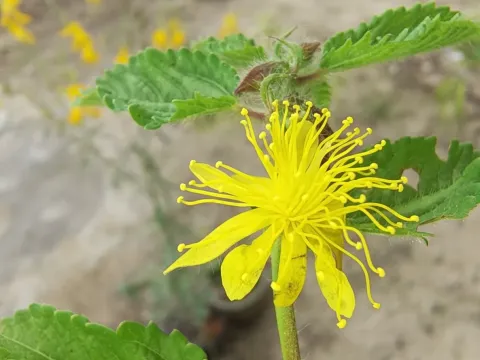
Corchorus hirtus
Corchorus hirtus
Corchorus hirtus is a tropical species, and its sowing must be synchronized with the onset of high temperatures, as seeds require soil temperatures above 20°C to germinate effectively.
What the section contains
Corchorus hirtus
In its native range, planting is typically aligned with the start of the rainy season, ensuring adequate moisture for initial seedling development without the need for extensive irrigation.
To optimize field performance, seeds should be sown in rows spaced 30 to 45 centimeters apart, allowing for sufficient light penetration and airflow as the plants grow and develop their branching structures.
Pre-soaking seeds in warm water is a recommended practice to improve germination uniformity, helping the crop establish itself quickly and gain a competitive edge against potential weed pressure.
Avoid planting in cold or waterlogged soils, as these conditions are highly detrimental to seedling emergence and can significantly increase the rate of post-emergence fungal infections.
As a member of the Malvaceae family, Corchorus hirtus thrives in warm, sunny environments. It is strictly a frost-sensitive plant that requires a long, stable growing season to achieve its full potential.
The plant performs best in fertile, well-draining soils with a neutral pH. Poor drainage is a significant limiting factor, as the roots are highly susceptible to rot when subjected to prolonged saturation.
Consistent moisture is vital for the development of high-quality fiber. Drought stress during the vegetative phase can lead to woody, brittle stems, which negatively impact the strength and yield of the fiber.
Fertilization management, specifically the application of nitrogenous compounds during the early stages, is effective in promoting rapid biomass accumulation, which is essential for industrial fiber production.
Due to its biological adaptation to equatorial climates, the species is best suited for cultivation in regions where seasonal temperature fluctuations are minimal and the growing season is long.
The total biomass yield of Corchorus hirtus is heavily dependent on maintaining optimal growth conditions throughout the vegetative cycle and minimizing resource competition from weeds.
The industrial value of the crop is determined by the yield of high-quality bast fiber. Harvesting at the peak of the flowering stage ensures that the fiber content and tensile strength are at their absolute maximum.
Under managed field conditions, farmers can expect a yield ranging from 15 to 25 tons of green biomass per hectare, depending on soil fertility and the efficacy of water management practices.
Efficient extraction of fiber is critical to the economic viability of the crop. Advanced retting techniques significantly influence the final output, ensuring that the processed fiber is clean and free of woody impurities.
Yield stability is improved through the implementation of crop rotation strategies, which help maintain soil nutrient levels and prevent the buildup of soil-borne pathogens that thrive in monocultures.
Leaf-eating insects represent the primary pest threat to Corchorus hirtus, as they can cause significant defoliation, reducing the plant's photosynthetic capacity and hindering its growth.
Root rot, often associated with poorly managed irrigation or heavy soils, is the most common disease. Improving soil aeration and drainage are the most effective preventive measures against such fungal issues.
Leaf spot diseases, exacerbated by high humidity and stagnant air, can occur in dense plantings. Proper plant spacing is essential to ensure adequate air circulation and reduce the incidence of fungal outbreaks.
Integrated Pest Management (IPM) is the preferred approach, emphasizing crop hygiene, the destruction of infected plant debris, and the use of resistant genotypes whenever available.
Chemical control measures should be employed judiciously to avoid environmental contamination and preserve the market value of the natural fiber, which is often marketed based on sustainable production practices.
Harvesting should be timed precisely at the commencement of full bloom. At this stage, the chemical composition of the stem is ideal for the separation of the inner bast fibers from the woody core.
Mechanical harvesting via tractor-drawn mowers is standard for larger operations, ensuring a clean cut at the base of the plant to maximize fiber yield per unit area.
Retting, the process of submerged fermentation to degrade pectin and release fiber, is a critical step in the harvest sequence, requiring large, clean water sources and constant monitoring.
Following the retting process, fibers must be thoroughly washed to remove remnants of the woody inner core and then dried uniformly in the shade to maintain the integrity and color of the material.
Proper drying is the final step, preventing the fiber from becoming discolored or brittle. The resulting fiber is then baled and graded for specific industrial applications, ranging from textiles to composite materials.