
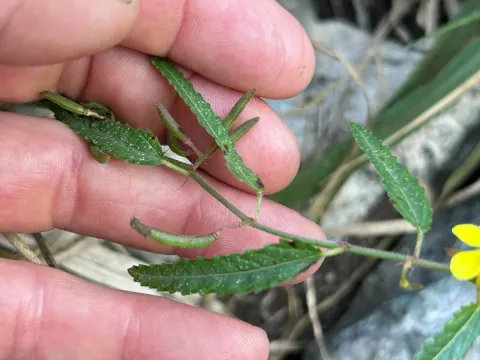
Corchorus asplenifolius
Corchorus asplenifolius
Corchorus asplenifolius belongs to the Malvaceae family. It is a perennial herbaceous plant native to the tropical and subtropical regions of Africa. The seeds are sown in well-warmed soil after the period of night frosts has passed, as the crop is extremely heat-demanding.
What the section contains
Corchorus asplenifolius
The optimal time for sowing is during the establishment of stable high temperatures, typically corresponding to early or mid-spring. Sowing is carried out in rows, with spacing that ensures adequate sunlight access for every individual plant.
The seeding depth is 2–3 centimeters, depending on the mechanical composition of the soil. During the first few weeks after emergence, it is essential to ensure high-quality weed control, as the plant exhibits relatively slow growth during its initial stages.
To accelerate seed germination, agronomists recommend soaking them in warm water for several hours before planting. This promotes more uniform emergence across the field and reduces the risk of plant loss in dense stands.
The selection of the planting site should exclude low-lying areas where rainwater might stagnate, as the crop does not tolerate waterlogging in the root zone. Open, well-lit areas with southern exposure are preferred to achieve maximum biological productivity.
The crop has high temperature requirements, preferring consistently hot growing conditions. For normal vegetation, the plant requires temperatures ranging from +22 to +30 degrees Celsius; lower temperatures significantly slow down photosynthesis.
Soils for successful cultivation must be fertile, with a neutral or slightly acidic pH. Loamy and sandy loam soils, which possess high aeration and the ability to retain moisture without the risk of waterlogging, yield the best results.
The plant demonstrates moderate resistance to short dry periods; however, regular irrigation during critical growth stages is required to obtain high-quality raw material. In arid regions, the use of drip irrigation allows for a substantial increase in green mass yield.
Agricultural practices include the application of organic fertilizers before plowing, which improves soil structure and nutrient accumulation. Mineral fertilization with nitrogen during the period of intensive vegetative growth promotes active shoot development.
Crop rotation is an important factor, as continuous monoculture on the same plot for several years leads to the accumulation of specific soil pathogens. It is recommended to return the crop to the same field no sooner than after three or four years.
The economic value of Corchorus asplenifolius lies in the production of strong plant fiber and the use of green mass as a feed additive or biomass source. Yield varies significantly depending on water availability and the level of agricultural care.
Maximum productivity is achieved with intensive irrigation and timely fertilization, which ensure a dense canopy. The green mass has high nutritional value, containing a significant amount of protein and essential micronutrients.
The technical fiber obtained from the stems of this species has good strength characteristics and can be used in the textile industry or for producing eco-friendly packaging. Fiber quality directly depends on the plant's development stage at the time of harvest.
Biomass yield is estimated based on the plant density per hectare. By maintaining optimal sowing density, it is possible to achieve a high dry matter yield per unit area, making the crop economically promising in suitable climatic zones.
Yield statistics indicate that using modern varieties and following fertilization schedules allows for an increase in production output by 15–20% compared to extensive cultivation methods. Considering the potential of a specific hybrid is crucial when planning the harvest.
The main phytosanitary threats for this crop are related to fungal diseases that develop under high humidity conditions. Among them, root rots are the most common and can destroy a significant portion of the crop if irrigation regimes are mismanaged.
Insect pests, such as aphids and various leaf beetles, can cause significant damage during the initial growth stage. Control measures include both preventative practices and the selective use of bio-based insecticides.
To reduce the infectious background, deep autumn plowing is recommended to destroy overwintering pests and disease pathogens. Keeping fields free from weeds also reduces the risk of viral diseases transmitted by insects.
Monitoring the condition of the crops should be carried out weekly for timely detection of infection centers. If signs of pathogens are identified, immediate control measures, including the application of systemic fungicides, must be taken.
During the flowering period, the plant becomes attractive to pollinating insects, which requires caution when choosing plant protection products. It is recommended to avoid applying high-toxicity pesticides during the day to minimize negative impacts on the entomofauna.
Harvesting is carried out depending on the intended use of the product. If the main goal is fiber production, mowing is performed during the peak flowering phase, when the stems reach maximum strength and flexibility while maintaining tissue elasticity.
For harvesting green mass for feed or mulch, the timing shifts to an earlier period of active growth. In this case, the high nutritional value of vegetative organs is important, which decreases as the plant enters the reproductive stage and the stems become lignified.
For mechanized harvesting, mowers are used to ensure an even cut of the stems at the required height. It is essential to ensure proper drying of the harvested material to prevent mold development and preserve the marketable quality of the fiber or feed mass.
After mowing, the stems can undergo a retting process if fiber extraction is required. This requires special tanks or natural water bodies with flowing water, where the fiber separates from the woody residues of the stem through enzymatic processes.
After the harvest is completed, the remaining vegetation can be incorporated into the soil as green manure if it has not been harvested for production needs. This contributes to restoring soil fertility and improving its physical and chemical properties for subsequent crops.