
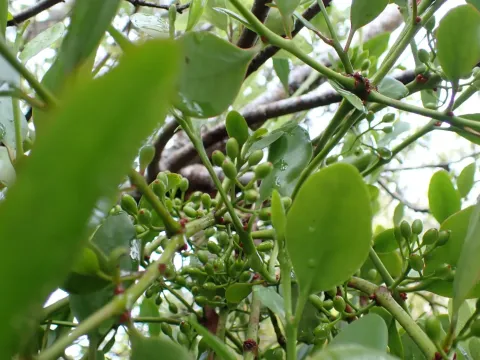
Ileostylus
Ileostylus
Ileostylus (Latin: Ileostylus) belongs to the Loranthaceae family. It is a genus of evergreen hemiparasitic shrubs that have evolutionarily adapted to life on other woody plants. Unlike many other mistletoes, this genus is not an obligate parasite in the strict sense, displaying some plasticity in its choice of hosts.
What the section contains

Ileostylus
The natural range of this plant is limited to New Zealand and Norfolk Island. It prefers a moderately warm climate with a sufficient level of humidity. The plant can be found both in natural forest stands and in open spaces where suitable host species are present.
Biologically, the culture is adapted to life in the canopies of trees and shrubs, using haustoria to extract water and mineral substances from the host plant's xylem. However, possessing a developed photosynthetic system, the plant is capable of partially providing itself with carbohydrates independently.
For normal development, Ileostylus requires diffused lighting and a stable supply of moisture through the host's root system. It does not tolerate extreme droughts, which limits its distribution to specific microclimatic zones where air humidity is maintained at a high level.
Agrotechnical cultivation of this species for agricultural purposes is not conducted. The plant is considered exclusively an object of botanical flora study and a component of natural ecosystems that requires protection in its natural habitats.
The main threats to Ileostylus are associated with the loss of natural habitats and the decline in the populations of specific bird species that act as the primary dispersers of its seeds. The seeds of the plant are covered with a sticky coating, which allows them to anchor to tree branches after passing through the bird's digestive tract.
Diseases affecting Ileostylus directly are poorly studied, as the plant itself occupies the niche of an organism that monitors the host's health. However, in cases of excessive growth on weakened trees, the plant can become the cause of their death due to the depletion of the host's resources.
Pests, such as specific types of insects that feed on leaves or wood, can cause localized damage to populations. Nevertheless, the most serious factor remains human impact, including deforestation and changing climatic conditions in the region.