
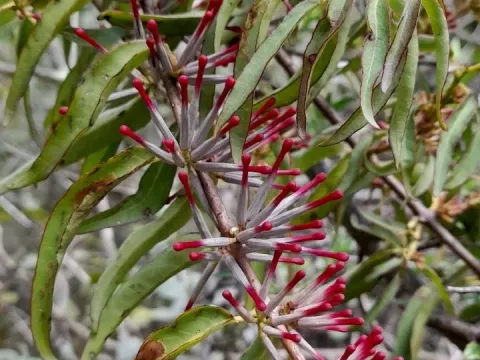
Englerina
Englerina
The genus Englerina belongs to the family Loranthaceae. These plants are known as hemiparasites, meaning they possess chlorophyll for photosynthesis but rely on host trees for water and dissolved mineral nutrients.
What the section contains
Englerina
Native to tropical and subtropical Africa, these plants inhabit diverse landscapes ranging from dense rainforests to open savannahs. They demonstrate a high degree of host specificity or general adaptability depending on the particular species within the genus.
Botanically, Englerina is distinguished by its modified root system called haustoria. These structures effectively penetrate the host's xylem and phloem, establishing a vascular connection that allows for the extraction of essential life resources.
The reproduction strategy of Englerina relies on colorful, bird-pollinated flowers. The resulting fruits are typically sticky berries, which are dispersed by birds who wipe the seeds onto the branches of other trees, facilitating the spread of the parasite.
While Englerina is not an agricultural crop, it is of ecological interest due to its impact on forest ecosystems. Management practices in forestry often focus on controlling such hemiparasites to maintain the health and vigor of commercially important timber species.