
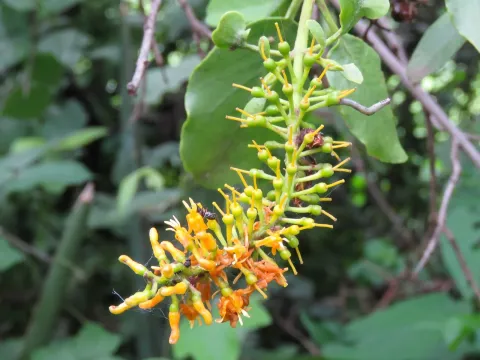
Helixanthera
Helixanthera
Helixanthera is a genus of hemiparasitic flowering plants belonging to the family Loranthaceae. These plants are known for their ability to thrive by attaching themselves to woody host plants via haustoria, which penetrate the bark to extract water and mineral nutrients from the host's xylem.
What the section contains

Helixanthera
Botanically, these plants appear as woody shrubs with typically leathery foliage that helps them survive in canopy environments. Their flowers are often elongated and brightly colored, specifically adapted to be pollinated by nectar-feeding birds, which facilitates successful seed dispersal across the forest canopy.
The geographic distribution of Helixanthera is primarily focused in the tropical and subtropical regions of Asia and Africa. They are well-adapted to high-humidity forest ecosystems, where they form complex interactions with a wide range of host tree species.
Environmental requirements for these plants include consistent warm temperatures and high levels of atmospheric humidity. They are strictly tropical organisms, and they cannot survive in climates with frost, dry seasons, or significant seasonal temperature fluctuations.
While not a traditional agricultural crop, Helixanthera has ecological significance as a component of biodiversity. However, in some tropical orchards and forestry systems, it is managed as a pest that can reduce the vigor of host trees, requiring periodic removal to protect the health of commercial crops.