
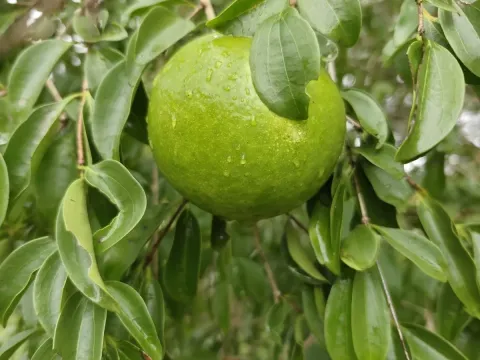
Natal orange
Strychnos spinosa
Strychnos spinosa, commonly known as the Natal orange or monkey orange, belongs to the Loganiaceae family. It is a deciduous, spiny shrub or small tree native to the tropical and subtropical regions of Africa, well-adapted to diverse environments.
What the section contains
Natal orange
The plant is renowned for its remarkable drought tolerance. Its root system is deep and expansive, allowing the tree to thrive in regions where rainfall is erratic and seasonal, making it an excellent candidate for semi-arid agriculture.
Regarding soil preferences, the Natal orange is highly versatile. It grows successfully in various soil types, ranging from sandy loams to rocky substrates, provided that the drainage is adequate to prevent waterlogging during wet periods.
The tree requires significant sunlight for optimal canopy development and fruit production. While it can withstand moderate competition in its youth, it should be spaced appropriately in plantations to ensure maximum solar interception for each tree.
Propagation is primarily done via seeds, which require specific conditions for germination. Once established, the tree requires minimal maintenance, as it is naturally adapted to survive with limited nutritional input and low water availability.
The economic value of Strychnos spinosa lies in its large, globose fruits, which feature a hard, woody shell. These fruits are a vital source of nutrition in many African communities, containing a pulpy interior rich in Vitamin C and citric acid.
A healthy, mature tree can produce a substantial yield, often ranging from several dozen to over a hundred fruits per season. Yield potential is influenced by tree age, site quality, and the presence of pollinators, which play a crucial role in fruit set.
Post-harvest, the fruit is utilized for various products, including fresh juice, jams, and traditional fermented beverages. Its long shelf life, protected by the hard shell, makes it an excellent commodity for local markets.
However, it is vital to emphasize that while the pulp is edible, the seeds are generally considered toxic due to the presence of alkaloids. Proper processing and separation are required to ensure the safety of food products derived from this plant.
As a low-input crop, the Natal orange offers significant potential for sustainable agricultural systems. Its ability to provide food without the need for intensive irrigation or synthetic fertilizers makes it a sustainable choice for tropical fruit production.
The Natal orange possesses natural chemical defenses, including various alkaloids, which protect it from a wide range of pests. This inherent resistance significantly reduces the need for chemical intervention in commercial orchards.
Potential threats include fungal infections affecting the bark, particularly in areas with poor airflow or consistently high humidity. Management strategies focus on sanitation and pruning to maintain an open canopy structure.
Insects such as aphids or certain Lepidoptera larvae may attack young foliage. In such cases, integrated pest management (IPM) practices, emphasizing biological control and monitoring, are sufficient to mitigate any damage to the plant.
Wildlife, particularly rodents and birds, may pose a risk to maturing fruits. The hard shell provides some natural protection, but protective measures such as netting or timely harvesting are necessary to prevent significant post-ripening losses.
Biosecurity is a key factor in protecting these plantations. Ensuring that no infected plant material is introduced to the farm is critical, as regional pests can quickly compromise the health and productivity of the trees.
Harvesting Natal oranges requires identifying the correct stage of maturity, characterized by a transition in shell color and the development of the fruit's distinct aroma. Harvesting too early can result in an excessively acidic and bitter taste.
The harvesting process is manual. Due to the presence of sharp, woody spines on the branches, laborers must use proper protective equipment to avoid injuries while collecting the fruit from the crown of the tree.
Once harvested, the fruits are highly durable and easy to transport due to their thick, protective outer layer. This robustness allows for storage at room temperature for an extended period, reducing the need for cold chain infrastructure.
Following collection, the fruits are usually sorted by size and quality. The extraction of the pulp from the hard-shelled fruit requires mechanical techniques to ensure that the bitter or toxic seeds are completely removed.
The efficiency of the harvest is enhanced by the tree's natural growth habit. Because the fruits are large and relatively heavy, they are easy to locate and gather, which streamlines the labor-intensive aspects of orchard management.