
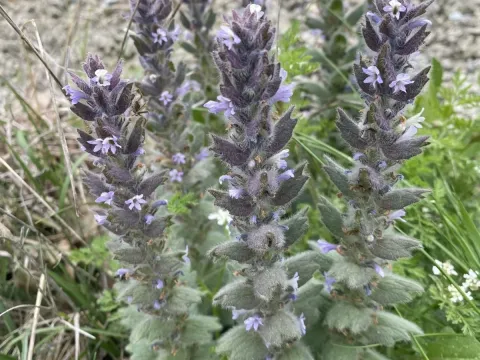
Oriental bugle
Ajuga orientalis
Oriental bugle is propagated primarily by seeds or vegetatively through division of the clump. Sowing seeds in open ground is carried out before winter or in early spring when the soil warms up to 10 degrees.
What the section contains
Oriental bugle
When sowing for seedlings, seeds are sown in March in boxes with a light substrate. An important condition for germination is stratification of seeds, which is carried out for a month at low temperatures.
Vegetative propagation by cuttings or rosettes is carried out throughout the growing season, but the optimal time is considered the end of spring or early autumn for better rooting.
When planting young plants, a scheme of 25 by 25 centimeters is observed to provide enough space for the spread of the ground cover.
Using mulch during planting allows protecting young plants from drying out and the excessive growth of weeds shortly after transplanting.
The culture belongs to the Lamiaceae family and is characterized by high plasticity to growing conditions. It prefers well-lit areas but is capable of developing in partial shade while maintaining the decorativeness of the leaves.
Oriental bugle is undemanding to soil conditions, however, it develops best on loamy, sufficiently moist, but drained substrates with a neutral reaction.
The plant tolerates winter frosts well, which is due to its origin from the mountainous and foothill regions of Eastern Europe and the Caucasus.
An important factor of development is moderate moisture. Under conditions of severe drought, growth slows down, so regular watering during the hot period has a positive effect on biomass.
The plant is an excellent ground cover, quickly forming dense carpets that suppress the development of unwanted weed vegetation in the area.
Slugs and snails pose the main threat to the oriental bugle, as they can feed on young succulent leaves during periods of high humidity.
With stagnant water in the soil, plants are susceptible to root rots, which cause wilting and the death of individual rosettes.
Under conditions of thickened plantings and poor ventilation, the development of fungal diseases is possible, such as powdery mildew, manifested by a characteristic white coating.
To control pests, agrotechnical methods are used, such as timely weeding and moderate watering, which prevents the reproduction of mollusks.
Prevention of fungal infections includes treatment with fungicides at the beginning of the growing season and maintaining optimal planting density to ensure air circulation.