
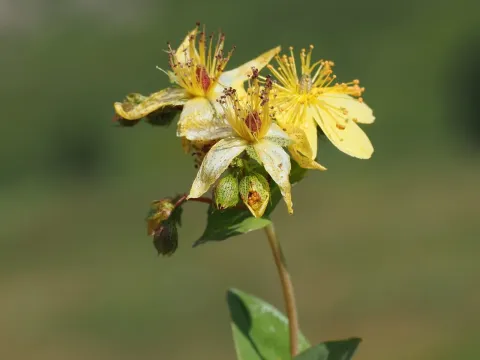
Richer's St. John's wort
Hypericum richeri
Sowing Richer's St. John's wort is best performed in late autumn or early spring when soil moisture is at its peak. The seeds are extremely fine, requiring a shallow sowing depth; they should be barely covered with soil to ensure they receive the light exposure necessary for germination.
What the section contains
Richer's St. John's wort
In professional farming, a seedling method is often preferred to establish stronger plants before field transplantation. If direct sowing is chosen, preparing a clean, weed-free seedbed is essential for the slow-growing seedlings to establish themselves successfully during the first season.
Row spacing should ideally be between 45 and 60 centimeters, providing enough room for maintenance activities and mechanical weeding between rows. As a perennial plant, long-term spatial planning within the crop rotation schedule is vital for sustainable production.
Stratification of seeds can improve germination rates, particularly if spring temperatures fluctuate significantly. Ensuring a consistent seed distribution is important, as the seedlings do not compete well with weeds in the early stages of development.
Firming the soil after sowing helps maintain the necessary contact between the tiny seeds and the soil surface. Adequate hydration during the initial weeks is critical to prevent the small seedlings from drying out before their root systems can penetrate deeper into the soil.
Richer's St. John's wort belongs to the Hypericaceae family and naturally inhabits subalpine meadows and mountainous slopes. It thrives in conditions characterized by high solar radiation, which is essential for the accumulation of its secondary metabolites and medicinal components.
The plant prefers moderately fertile, well-drained soils with a pH ranging from neutral to slightly acidic. It is highly sensitive to waterlogging, which can rapidly damage its root system; therefore, fields with high water tables or poor drainage should be avoided entirely.
While the plant shows resilience to moderate drought, achieving high biomass yields requires regular irrigation during prolonged dry spells. The optimal growth temperature is between 18 and 25 degrees Celsius, mirroring its native mountainous habitat.
The species is well-adapted to temperature variations but requires protection from severe, drying winds. Site selection should prioritize areas that receive maximum sunlight throughout the day while offering some protection against extreme winter exposure.
A porous soil structure is necessary to ensure proper aeration for the roots. Incorporating balanced organic matter during site preparation creates a nutrient-rich foundation that supports the plant's growth over several years of production.
Fungal diseases are the primary threat to Richer's St. John's wort, especially in humid climates or poorly ventilated fields. Root rots and powdery mildew can significantly compromise both the vitality of the plant and the quality of the harvested herbal material.
Leaf-eating insects and certain caterpillars can cause substantial damage to the foliage, thereby reducing the photosynthetic capacity of the plant. Regular monitoring is essential to identify early pest infestations and implement integrated pest management strategies.
Improper agronomic practices, such as over-irrigation, are the most frequent cause of root diseases. Maintaining proper plant density and ensuring good airflow between rows are the most effective preventive measures against the spread of pathogens.
Chemical intervention is generally avoided due to the medicinal use of the plant, favoring biological and cultural controls instead. Keeping the field free of weeds and maintaining soil health are fundamental to reducing the risk of disease outbreaks.
Weed management is most critical during the first year of establishment. If weeds are allowed to compete, the development of the St. John's wort will be stunted, potentially leading to sparse and unproductive plantations.
Harvesting Richer's St. John's wort should occur during the full flowering stage, which is when the concentration of essential oils and bioactive compounds is at its peak. Timing this window is crucial for maintaining the pharmacological efficacy of the final product.
The harvest method involves cutting the aerial flowering stems at a height of approximately 15 to 20 centimeters above the ground. This preserves the basal portion of the plant, allowing it to recover and produce a new canopy in subsequent seasons.
Immediate post-harvest processing is required, as the cut material must be dried in shaded, well-ventilated conditions. The drying temperature should not exceed 45 degrees Celsius to prevent the degradation of volatile and heat-sensitive components.
Once dried, the herb is cleaned of debris and stems to meet quality standards. Storing the final product in light-proof and moisture-proof containers is essential to protect the integrity of the herb during storage and transport.
Under favorable growing conditions, a second harvest may be possible late in the season. However, growers should exercise caution to avoid over-harvesting, which can weaken the plant and reduce its cold-hardiness before the dormant winter period.