
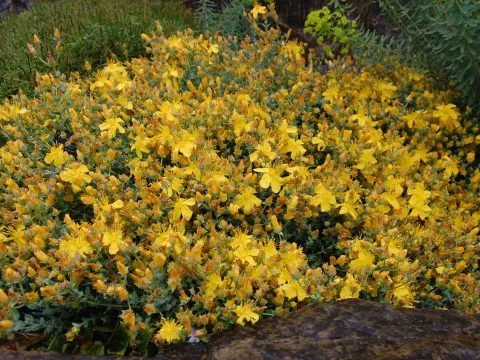
Many-leaved St. John's wort
Hypericum polyphyllum
Hypericum polyphyllum, known as many-leaved St. John's wort, is a resilient perennial plant belonging to the Hypericaceae family, valued for its bright yellow flowers and medicinal properties.
What the section contains
Many-leaved St. John's wort
Propagation is typically achieved through seeds, which should be sown in early spring in well-prepared seedbeds to ensure a strong root system development.
The seeds are small and require surface sowing, barely covered with a thin layer of substrate, as they need light to germinate efficiently.
Using a greenhouse for initial seedling development in late winter allows for earlier planting in the field once the threat of frost has completely passed.
Proper spacing between plants is crucial, with recommended density allowing for optimal airflow to prevent moisture buildup around the base of the stems.
This species thrives in full sun and is highly adapted to rocky or sandy soils, mirroring its natural alpine and steppe habitat conditions.
It is remarkably drought-tolerant once established, requiring deep watering only during prolonged dry spells to maintain healthy foliage growth.
The ideal soil should be well-drained with a slightly alkaline or neutral pH, as the plant is sensitive to waterlogged conditions that can cause root rot.
Low temperatures are generally well-tolerated, although some protection with organic mulch is advisable during harsh winters to protect the crown.
Minimal fertilization is required; a light application of balanced fertilizer in the early spring is sufficient to support seasonal growth and prolific flowering.
The most common issues affecting this crop include fungal infections like rust and powdery mildew, often triggered by excessive humidity and stagnant air.
Insect pests, including aphids and leaf beetles, may occasionally attack the plants, requiring vigilant monitoring during the active growth phase.
Cultural control methods, such as removing debris and ensuring proper site drainage, are the first line of defense against both diseases and pests.
If chemical intervention becomes necessary, it should be timed carefully to avoid damaging the medicinal quality of the harvested aerial parts.
Regular weeding is essential to reduce competition for nutrients and water, which otherwise weakens the plants and makes them more susceptible to pathogens.
Harvesting the aerial parts should be performed at the peak of the flowering stage, ensuring the concentration of active chemical constituents is at its maximum.
The stems should be cut using clean, sharp tools, leaving enough foliage for the plant to recover and produce a second flush of blooms if the climate allows.
Drying must occur in a well-ventilated, shaded area to protect the integrity of the volatile oils and pigments within the leaves and flowers.
Once dried to a crisp texture, the product should be packed in airtight containers and kept in a cool, dark environment to maintain its potency.
Consistent quality control during harvesting and drying ensures that the final product meets market standards for medicinal and ornamental applications.