
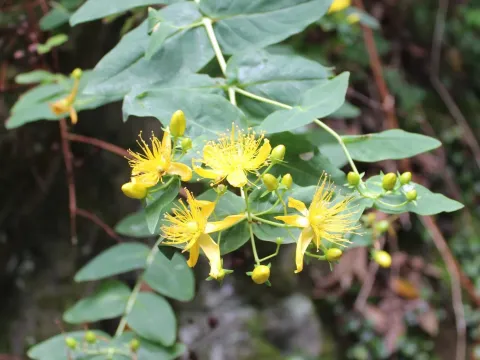
Large-leaved St. John's wort
Hypericum grandifolium
The sowing of Hypericum grandifolium seeds is typically performed in early spring once soil temperatures reach a consistent range of 10 to 12 degrees Celsius.
What the section contains
Large-leaved St. John's wort
Due to the extremely small size of the seeds, they should be sown on the surface of the soil with minimal to no covering, as burial deeper than 0.5 cm significantly inhibits germination.
To ensure optimal crop development, row spacing should be maintained at 45 to 60 cm, allowing for adequate light penetration and airflow for individual plants.
Germination typically occurs within three weeks of sowing, provided that the soil surface is kept consistently moist during this critical phase.
For commercial cultivation, vegetative propagation through root division is also viable, allowing for uniform establishment of new plant rows.
Hypericum grandifolium, a member of the Hypericaceae family, originates from the Macaronesian region, favoring temperate maritime conditions.
The plant thrives in well-drained, sandy-loam soils; it is highly intolerant of waterlogged conditions, which often lead to root decay.
Full solar exposure is essential for this species, as shading reduces the accumulation of secondary metabolites, which are vital for its medicinal utility.
Although it possesses some drought tolerance, regular irrigation is required during the initial growth phases and throughout the peak of the summer season.
The species is sensitive to extreme frost, requiring winter protection or careful site selection in regions where winter temperatures drop significantly below freezing.
Yield capacity typically peaks from the second to the fourth year of growth as the plant establishes a robust root system and woody stem structure.
Average biomass yields for dried material range between 1.5 and 2.5 metric tons per hectare under intensive management and optimal fertilization.
The primary economic focus involves harvesting the aerial parts for pharmacological purposes due to the presence of specific active constituents.
Judicious pruning of older branches after the flowering season can encourage new vegetative growth, thereby maintaining consistent annual yields.
Proper soil fertility management, specifically the application of balanced NPK fertilizers, helps sustain high productivity over the lifecycle of the crop.
Fungal diseases, including powdery mildew and fusarium wilt, are the primary biological threats, especially when humidity levels remain high for extended periods.
Pest management should focus on monitoring for leaf-eating beetles and spider mites, which can cause severe defoliation if left unchecked.
Cultural practices such as maintaining wide row spacing and ensuring adequate soil drainage are the most effective preventative measures against pathogen spread.
When chemical intervention is required, it must be performed early in the season to prevent residue accumulation in the harvested material.
Integrated Pest Management (IPM) strategies, including the use of beneficial insects, are encouraged to protect the overall quality of the harvest.
Harvesting should be timed precisely to the phase of maximum bloom, as this is when the concentration of essential active components is at its peak.
Mechanical harvesting tools are used to cut the stems, leaving sufficient basal structure to ensure the plant recovers for the subsequent season.
Immediate post-harvest drying is critical; material must be spread in thin layers in shaded, ventilated areas to maintain quality and prevent spoilage.
Once dried to a moisture content of approximately 10-12%, the material is cleaned and processed into specific fractions for market use.
Storage must occur in climate-controlled environments that prevent exposure to light and excess humidity, protecting the shelf-life of the chemical components.