
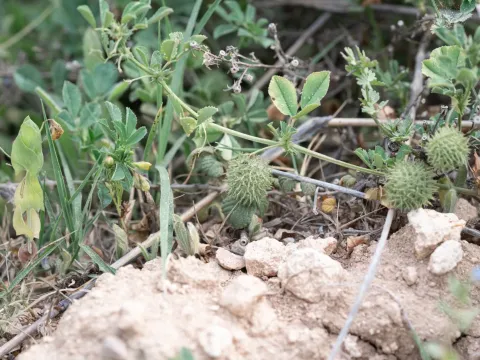
Ciliated medick
Medicago ciliaris
Ciliated medick is an annual legume species belonging to the Fabaceae family. Sowing is typically performed in the early spring once soil temperatures reach 8–10 degrees Celsius to ensure robust and uniform germination.
What the section contains
Ciliated medick
Moisture availability in the topsoil layer is a critical factor during the sowing period. In temperate regions, early planting allows the crop to establish a strong root system before the onset of intense summer heat, which can lead to seedling desiccation.
The seeding rate should be adjusted based on soil fertility and the chosen planting method. A row-seeding approach is generally recommended to provide each plant with adequate space, access to sunlight, and sufficient nutrients for optimal vegetative growth.
The planting depth should not exceed 1–2 centimeters, as the seeds are relatively small. Planting too deep can hinder seedling emergence, while surface sowing leaves the seeds vulnerable to drying out before they can germinate.
Post-sowing soil compaction is essential to ensure good seed-to-soil contact. This practice promotes moisture absorption via capillary action, which significantly increases field emergence and ensures a more uniform growth pattern across the field.
This species is well-adapted to Mediterranean climates and requires open, sunny locations for optimal development. It is highly sensitive to competition and shade from taller vegetation, which can significantly reduce its biomass production.
Ciliated medick thrives in fertile loamy soils with a neutral or slightly alkaline pH. While it is somewhat tolerant of different soil textures, it requires excellent drainage, as waterlogged conditions are highly detrimental to its root system.
A key biological advantage of this plant is its ability to establish symbiotic relationships with nitrogen-fixing bacteria. This trait improves soil nitrogen levels and reduces the need for synthetic fertilizers, making it a sustainable choice for crop rotations.
The plant exhibits moderate drought resistance due to its deep taproot, allowing it to survive in regions with variable rainfall. However, peak vegetative yields are only achieved when adequate moisture is available during the stem elongation phase.
Temperatures should be moderate throughout the growing season. While the crop is reasonably robust, it is vulnerable to late spring frosts during the initial growth stages, so careful site selection is necessary to avoid frost pockets.
Common diseases affecting this crop include various leaf spot pathogens and root rots, which often proliferate under high humidity. Crop rotation and maintaining optimal plant density are the primary methods for preventing the spread of these infections.
Pests such as the clover weevil and various aphid species can cause significant damage to foliage and developing buds. Regular field scouting is necessary to identify outbreaks before they reach economic damage thresholds.
Weeds are the primary competitor during the early vegetative stages, as the plant grows slowly at first. Proper land preparation and mechanical weeding are essential to ensure the medick establishes itself without competition from invasive weeds.
To reduce disease pressure, it is important to use only high-quality, treated seed lots. Avoiding the cultivation of leguminous crops in the same field for several consecutive seasons helps break the life cycles of soil-borne pathogens.
An integrated pest management (IPM) strategy is highly recommended to manage threats effectively. This involves using biological controls where possible, monitoring pest populations closely, and limiting the use of chemical interventions.