
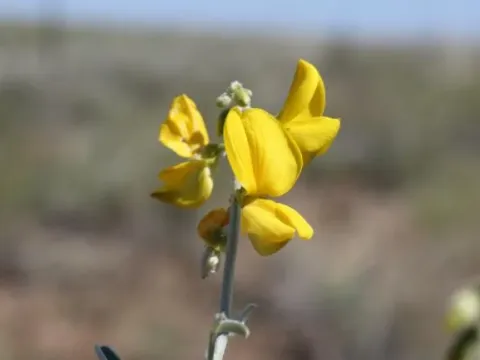
Crotalaria dissitiflora
Crotalaria dissitiflora
Crotalaria dissitiflora is a heat-loving leguminous plant that requires warm soil conditions for successful germination and early growth.
What the section contains
Crotalaria dissitiflora
Sowing should be delayed until all risks of frost have passed and soil temperatures have consistently reached at least 15-18 degrees Celsius.
The seeds are typically sown in rows to facilitate uniform stand development and to reduce weed competition through dense canopy formation.
Correct seed depth is crucial; placing seeds at 2 to 3 centimeters ensures adequate moisture contact without hindering the emergence of delicate shoots.
Proper field preparation and a light irrigation immediately after sowing can significantly increase the emergence rate of the crop.
As a member of the Fabaceae family, this species is highly valued for its ability to fix atmospheric nitrogen and enrich depleted soils.
The plant thrives in full sunlight, requiring well-exposed locations to achieve its maximum potential for biomass production.
Soil requirements focus on good drainage, as Crotalaria dissitiflora is susceptible to root damage in waterlogged or heavy, compacted soil types.
It prefers slightly acidic to neutral soil pH levels, which optimize the activity of nitrogen-fixing bacteria within the root nodules.
Once established, the crop demonstrates excellent resilience to heat and dry spells, making it a sustainable choice for challenging climates.
Fungal diseases are the primary threats, often occurring when high humidity levels coincide with poor field ventilation or over-irrigation.
Root rot can become a significant issue in fields with poor drainage, leading to stunted plant development and overall loss of stand density.
Insect pests, particularly aphids and various beetles, can cause damage to tender foliage during the initial stages of vegetative development.
Implementing a balanced crop rotation is the most effective strategy for managing soil-borne diseases associated with this leguminous crop.
Integrated pest management, including the use of beneficial insects, is recommended to protect the crop without disrupting the field ecosystem.
When used as a green manure, the crop should be harvested or mowed during the early flowering stage to maximize nutrient incorporation.
Mowing should occur before the stems become overly lignified, as tender material decomposes much faster in the soil profile.
The harvested biomass should be chopped and incorporated into the top 10-15 centimeters of soil using disk harrows to start the mineralization process.
For seed production, harvesting is delayed until the pods become dry and change color, indicating that the seeds have reached full maturity.
Proper post-harvest drying is essential to prevent mold growth and to maintain high seed viability for the following growing season.