
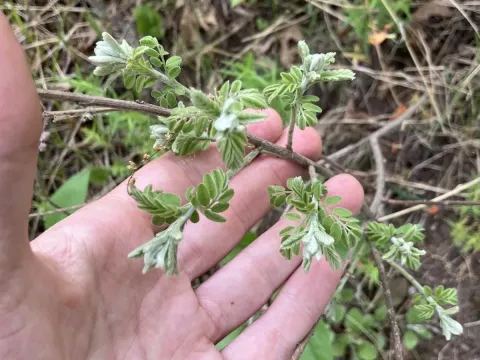
Leadplant
Amorpha canescens
Leadplant is typically propagated by seeds, which require stratification to break dormancy and ensure uniform germination in a controlled field environment.
What the section contains
Leadplant
Sowing should take place in late autumn or early spring, placing seeds at a depth of approximately 1.5 to 2 centimeters to ensure adequate moisture contact.
Site preparation is critical; because the species establishes slowly, the field must be completely cleared of competitive perennial weeds before sowing.
Spring planting is preferred when soil temperatures reach at least 10–12 degrees Celsius, providing the necessary heat for early root development.
Spacing should be optimized based on the objective, whether the planting is intended for soil stabilization, ornamental use, or bee foraging purposes.
As a member of the Fabaceae family, Amorpha canescens is exceptionally hardy and excels in dry, well-drained, and nutrient-poor soil conditions.
This species is a quintessential sun-lover, requiring full sun exposure to maintain vigorous growth and produce sufficient nectar for pollinators.
The plant possesses a profound taproot system, which serves as an adaptation to drought, allowing it to survive in arid climates with minimal precipitation.
It is remarkably tolerant of high temperatures in summer and exhibits excellent cold hardiness, surviving harsh winter conditions without protection.
Soil pH preference is broad, although neutral to slightly acidic soils with a loose texture are ideal for maximizing the longevity of the plant stand.
The primary agricultural value of leadplant lies in its role as a high-quality late-season nectar source, making it a valuable asset for commercial beekeeping.
As a nitrogen-fixing legume, the plant significantly enhances soil health and nutrient cycling, benefiting subsequent crops in a rotation system.
Its deep root structure makes it an excellent choice for erosion control, especially on steep slopes and sandy terrain that are prone to wind or water movement.
The biomass produced can be utilized as green manure, adding organic matter to the soil profile and improving its moisture-holding capacity over time.
- Natural nitrogen fixation capability.
- Superior soil erosion protection.
- High value for native and honeybee conservation.
Excessive soil moisture is the primary threat to leadplant, often leading to the development of fungal root rot diseases during unusually wet seasons.
Seedlings are susceptible to damage from subterranean insects like wireworms, which can significantly reduce plant density during the first year.
Foliar pests, particularly aphids, may infest the leaves and stems, stressing the plant and reducing its overall nectar production efficiency.
In humid regions, leaf spot pathogens can occur, necessitating good air circulation and appropriate spacing to mitigate disease pressure on the field.
Integrated pest management strategies focusing on early detection and preventative sanitation are essential for maintaining a healthy and productive crop stand.