
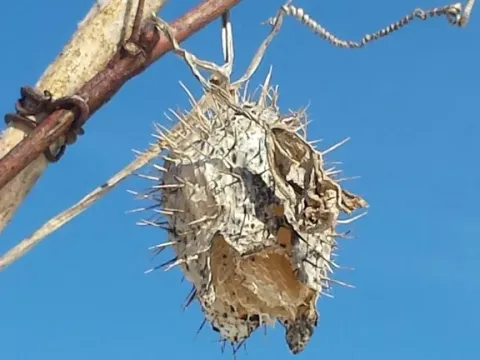
Echinocystis
Echinocystis
Echinocystis, commonly known as wild cucumber, is an annual herbaceous vine belonging to the Cucurbitaceae family. It is often regarded as a vigorous weed rather than a cultivated crop.
What the section contains


Echinocystis
The plant propagates solely through seeds, which exhibit high longevity and can remain dormant in the soil for several seasons before germinating under favorable conditions.
Seed germination typically occurs in early spring as soil temperatures warm up. Shallow planting at depths of 2–5 cm is ideal for the successful emergence of seedlings.
During the peak growing season, the plant displays explosive growth, with vines capable of extending several meters in length, using tendrils to climb nearby structures or vegetation.
In managed landscapes, it is sometimes used for vertical screening due to its ability to create dense, leafy coverage in a short amount of time.
Echinocystis thrives in moist and well-drained soils. It is frequently found along riverbanks, wetlands, and other areas with consistent moisture availability.
The plant shows a strong preference for full sunlight, which is necessary to fuel its rapid biomass accumulation throughout the summer months.
Regarding soil fertility, it prefers rich, fertile substrates but demonstrates significant adaptability to various soil types, provided they are not excessively compacted.
An essential requirement for its development is the availability of physical supports, such as fences or other plants, which allows the vine to maximize its exposure to sunlight.
Climate adaptation is a key strength of this species, allowing it to complete its life cycle within the relatively short growing seasons of temperate regions.
The plant is susceptible to common Cucurbitaceae diseases, including powdery mildew, which can significantly reduce photosynthetic efficiency.
Downy mildew and anthracnose are also prevalent, causing necrotic spots and eventual decline of the foliage, especially under high humidity conditions.
Aphids represent a major pest risk, often congregating on the succulent shoots and undersides of leaves, causing structural damage and transmitting viral diseases.
Spider mites can become problematic during hot and dry spells, leading to yellowing and premature leaf senescence.
Integrated pest management strategies are often required to control its population, involving early-season mechanical removal and targeted herbicide applications to prevent seed set.