
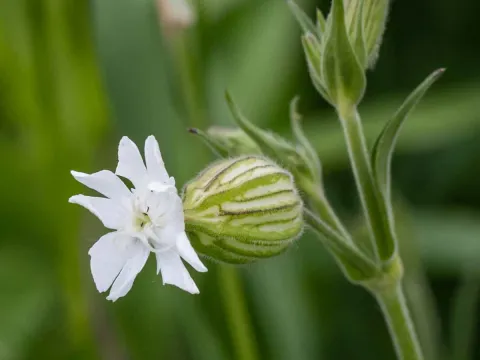
White campion
Silene alba
White campion (Silene alba), a member of the Caryophyllaceae family, is a herbaceous perennial or biennial plant native to Europe and western Asia, widely naturalized in North America.
What the section contains
White campion
It thrives in a variety of habitats, including fields, meadows, and disturbed lands, preferring nitrogen-rich, well-drained soils. Its adaptability allows it to colonize diverse agricultural landscapes effectively.
The plant features a stout taproot and branched stems that can grow up to 1 meter in height. Its lance-shaped leaves and white, nocturnal flowers make it a distinct species in meadow ecosystems.
Due to its high seed production and prolonged flowering season, it is often treated as a problematic weed in cultivated crops, competing for resources such as sunlight, soil moisture, and minerals.
Botanically, it is known for its dioecious nature, meaning male and female flowers are typically borne on separate individual plants, which ensures genetic diversity through cross-pollination.
White campion is susceptible to several pathogens, including the smut fungus which can infest its ovaries and replace the seeds with masses of fungal spores.
Various generalist insect herbivores, such as caterpillars and aphids, regularly feed on its leaves and buds, potentially reducing its competitive advantage against crops.
Cultural control practices, such as competitive planting and cover cropping, are essential for shading out germinating seedlings in agricultural environments.
Timely tillage operations are critical to disrupt the taproot development, especially during the first year of growth before the plant establishes itself permanently.
Chemical control remains a viable option in commercial farming, provided that herbicides are applied during the vegetative stage to ensure optimal uptake by the root system.