
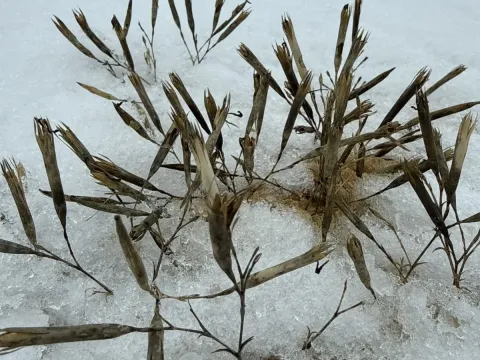
Velezia
Velezia
Velezia is a genus of annual herbaceous plants belonging to the Caryophyllaceae family. In an agricultural context, it is typically categorized as a weed rather than a cultivated crop, often found in disturbed environments.
What the section contains


Velezia
The plant reproduces primarily through seeds. Its lifecycle is adapted to colonizing open, disturbed ground, where the seeds can remain dormant in the soil bank for extended periods before germinating.
The biological strategy of Velezia focuses on rapid establishment and seed production, allowing it to compete effectively for limited resources in arid or degraded soil environments.
Agricultural management of this plant requires careful seedbed preparation. Disrupting the soil early in the season can stimulate germination, making it easier to eradicate the seedlings through mechanical harrowing.
Consistent crop rotation and weed monitoring are essential to prevent the accumulation of Velezia seeds in the topsoil, which could otherwise lead to persistent infestations in future seasons.
Velezia is highly adapted to dry, sunny environments. It is a drought-tolerant genus, capable of thriving in areas with low precipitation and high summer temperatures.
The plant is not demanding regarding soil quality. It frequently colonizes rocky, sandy, or alkaline soils where many other species struggle to survive, demonstrating its resilience.
Its natural distribution covers parts of the Mediterranean, the Caucasus, and Western Asia. These regions provide the dry, open habitats necessary for its growth and reproduction.
Optimal growth occurs in well-drained soils. Poor drainage or waterlogged conditions are major inhibitors, as the plant's root system is sensitive to prolonged anaerobic stress.
Exposure to full sunlight is a critical requirement for Velezia. It generally performs poorly in shaded areas or within dense crop canopies that limit light penetration.
As an agricultural weed, Velezia competes with crops for soil moisture and nutrients. Its deep taproot system allows it to exploit water resources that are crucial during dry spells.
The presence of this plant in fields can harbor various pests and pathogens, potentially serving as a vector or reservoir for diseases that affect nearby agricultural crops.
Mechanical control methods, such as cultivation and hoeing, are effective if performed before the plant reaches the flowering stage, thus preventing seed dispersal.
Integrated Pest Management (IPM) strategies for Velezia involve a combination of chemical herbicides and cultural practices, such as maintaining healthy, competitive crop stands to suppress weed growth.
Early detection is vital, as a single plant can produce a significant number of seeds, leading to a exponential increase in weed density if not managed during the initial stages of infestation.