
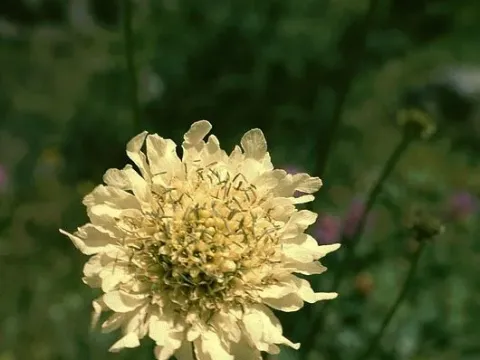
Yellow Cephalaria
Cephalaria flava
Yellow Cephalaria (Cephalaria flava) is a perennial herbaceous plant belonging to the Caprifoliaceae family. Native to mountain regions and meadows, it is highly regarded for its structural integrity and its role as a productive component in temperate landscapes.
What the section contains
Yellow Cephalaria
The plant thrives in well-drained, fertile soils with a neutral pH level. It possesses a deep taproot system, which allows the culture to withstand drought conditions efficiently once it is well-established in the field.
Climate requirements for this species include high solar radiation exposure, as it performs best in full sun. While it is hardy in cold temperatures, it must be protected from waterlogged soils, especially during dormancy, to prevent root decay.
Botanically, Cephalaria flava reaches heights of 100-150 cm. It produces distinct globular yellow inflorescences and pinnately divided leaves that form a dense foliage canopy, which is highly beneficial for suppressing weed growth in the area.
Economically, the crop is primarily utilized in sustainable agriculture as an excellent melliferous plant (honey plant). Additionally, its ability to thrive on slopes makes it an ideal candidate for soil stabilization and conservation programs.
Yellow Cephalaria generally exhibits a strong resistance to common agricultural pathogens. However, poor drainage can lead to opportunistic fungal infections, specifically root rot, which is why soil aeration is a critical management practice.
Pest pressure is relatively low, though aphids may occasionally colonize the soft tips of the stems during the peak growing season. Integrated pest management, focusing on biological controls, is typically sufficient to maintain plant health.