
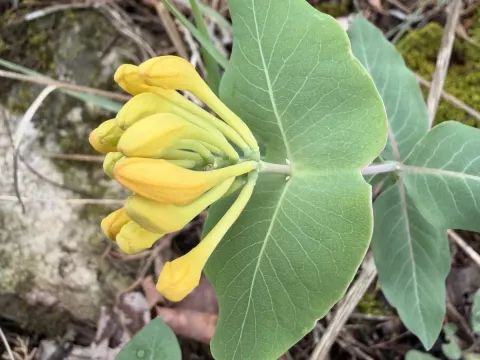
Yellow honeysuckle
Lonicera flava
Yellow honeysuckle (Lonicera flava) is a perennial flowering vine belonging to the Caprifoliaceae family. Native to North America, this species is well-adapted to temperate forest habitats and is prized for its ornamental qualities in garden settings.
What the section contains
Yellow honeysuckle
Botanically, it is recognized by its twining stems that can climb up to several meters. The plant features opposite, simple leaves and tubular, bright yellow to orange flowers that emerge in late spring or early summer, forming showy terminal clusters.
The plant thrives in locations with full sun to partial shade. For optimal growth, it requires deep, moist, but well-drained soil rich in organic matter. Providing protection from strong, drying winds is recommended to maintain the health of the foliage throughout the season.
Maintenance involves providing sturdy support structures such as trellises or fences. Routine pruning is essential to control the size of the plant, remove dead wood, and encourage denser growth and more prolific flowering in the following season.
In terms of usage, Lonicera flava is primarily grown for its aesthetic value in landscape architecture. It is an excellent choice for vertical gardening, enabling the coverage of pergolas, arbors, and walls with its lush foliage and vibrant, aromatic blooms.
Yellow honeysuckle is generally robust, but it can be susceptible to common garden issues such as powdery mildew. This fungal disease is often exacerbated by poor air circulation and high humidity levels, particularly during wet summer months.
Pests such as aphids and honeysuckle leaf miners can occasionally cause damage by feeding on young leaves and buds. Integrated pest management, including regular inspection and the use of insecticidal soap or biological controls, is highly effective in managing these infestations.