
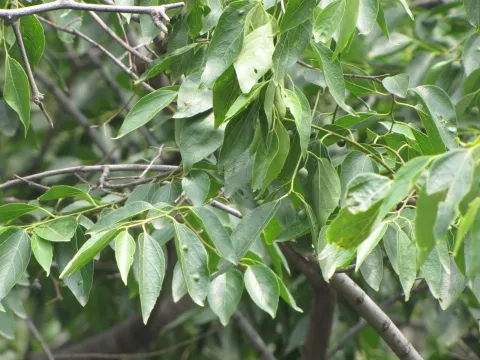
Bunge's hackberry
Celtis bungeana
Bunge's hackberry (Latin Celtis bungeana) is a deciduous tree belonging to the Cannabaceae family. Native to East Asia, specifically regions of China and Korea, this species is highly valued for its elegant form and adaptability to various environmental conditions in temperate zones.
What the section contains
Bunge's hackberry
The cultivation of this plant requires full sun exposure to maintain its characteristic dense canopy and healthy foliage. While it can tolerate partial shade in its juvenile stage, long-term growth and the development of a symmetrical shape are best achieved in open areas with plenty of natural light.
Regarding soil preferences, the tree thrives in deep, well-drained loamy soils with a neutral or slightly alkaline pH. Proper soil drainage is essential, as the roots are sensitive to waterlogging, which can lead to root decay and decreased vigor, particularly in heavy clay-based garden beds.
Botanically, Celtis bungeana is distinguished by its smooth gray bark, which becomes slightly textured with age, and its small, ovate leaves. The tree exhibits a sturdy growth habit, with deep roots that provide excellent stability against strong winds, making it a reliable choice for urban settings.
Economically and ornamentally, Bunge's hackberry is primarily utilized in landscaping and reforestation projects. Its wood, noted for its resilience and flexibility, has historical applications in traditional woodworking, while its small, dark berries attract local wildlife, enhancing the ecological value of any planting site.
Common issues for this species include occasional outbreaks of powdery mildew, especially in humid and poorly ventilated sites. Pests such as aphids and leaf-eating beetles may cause minor foliage damage, though typically, standard horticultural practices and proper plant spacing are sufficient to maintain tree health.