
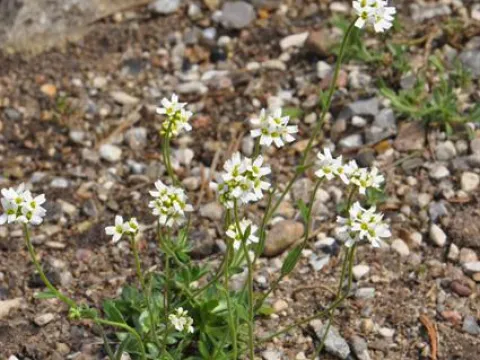
Lance-leaved whitlow-grass
Draba lanceolata
Lance-leaved whitlow-grass (Draba lanceolata) is a perennial herbaceous plant belonging to the Brassicaceae family. It is primarily known as a wild species adapted to high-altitude and harsh environments rather than a traditional cultivated crop.
What the section contains
Lance-leaved whitlow-grass
The plant is distinguished by its lanceolate leaves forming a basal rosette and thin, erect stems. Its morphology is evolved to survive in extreme habitats such as rocky slopes, screes, and gravelly ground where nutrient levels are generally low.
Its natural range extends across the northern regions of Eurasia and North America. It thrives in cooler climates and is capable of enduring significant temperature fluctuations, which is characteristic of alpine or arctic tundra ecosystems.
Regarding soil requirements, Draba lanceolata prefers well-drained, porous substrates, often with a calcareous composition. It avoids waterlogged areas and requires high levels of solar exposure to complete its reproductive cycle effectively during the short growing season.
While not a major commercial crop, it holds interest for research in plant biology and potential use in landscape architecture for rock gardens. Its cultivation is mostly restricted to botanical collections due to its specific ecological niche requirements.