
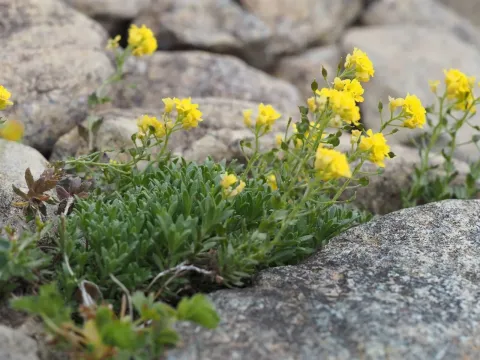
Japanese whitlow-grass
Draba japonica
Japanese whitlow-grass (Draba japonica) is a hardy perennial belonging to the Brassicaceae family. It is native to the high-altitude, rocky environments of East Asia, where it has evolved to thrive in nutrient-poor soils and under significant climatic stress.
What the section contains
Japanese whitlow-grass
This species is biologically adapted to extreme cold and fluctuating temperatures. Its compact growth habit and specific root structure allow it to survive in shallow mountain soils, making it a robust subject for specialized cultivation in similar temperate or sub-arctic zones.
Regarding soil requirements, Draba japonica demands excellent drainage. Heavy or clay-rich soils are unsuitable as they increase the risk of root rot. Ideally, the plant should be situated in gritty, sandy, or rocky substrates that mimic the natural scree slopes of its origin.
Agricultural management of this plant is minimal but precise. It requires full sun exposure and clear space; it is not tolerant of overcrowding or aggressive weeds. Maintenance typically focuses on preventing waterlogging rather than providing heavy chemical or organic soil amendments.
While Japanese whitlow-grass has no current status as a major commercial field crop, it is highly valued in horticulture. Its ability to colonize difficult spaces makes it an excellent candidate for alpine gardens and specialized landscape projects, serving as a low-maintenance groundcover.