
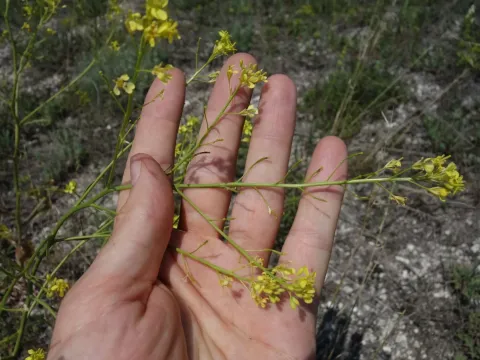
Elongated mustard
Brassica elongata
Elongated mustard is a herbaceous plant that functions as a persistent weed in various agricultural environments, particularly in cereal and fallow fields.
What the section contains
Elongated mustard
Germination typically occurs in the early spring, following soil temperature increases, although it can happen sporadically throughout the growing season.
The seeds demonstrate high viability and can remain dormant in the soil seed bank for several years, which significantly complicates agricultural weed management.
Autumn-germinating individuals establish a robust leaf rosette, allowing them to overwinter effectively and gain a head start in growth compared to spring-sown crops.
Due to its aggressive growth habit, the plant competes heavily for soil nutrients and moisture, making early mechanical intervention crucial for crop health.
Belonging to the Brassicaceae family, the species exhibits significant ecological plasticity, allowing it to colonize diverse landscapes from saline flats to dry fields.
The plant thrives in full sun exposure and is highly susceptible to competition, failing to develop vigorously in shaded or dense canopy conditions.
It prefers well-drained soils but shows high tolerance for extreme conditions, including nutrient-poor substrates and regions with high levels of alkalinity or salt.
While elongated mustard prefers moderate precipitation, its physiological traits make it drought-tolerant, surviving periods of limited water availability.
Its broad adaptability to varying thermal regimes ensures its survival across diverse geographic zones, often establishing stable populations in disturbed habitats.
The species is susceptible to standard cruciferous pathogens, including white rust and powdery mildew, which can become prevalent under humid conditions.
Flea beetles constitute the most common and damaging pest, often stripping leaf tissue from seedlings during the early stages of plant development.
The plant often acts as a botanical reservoir for various insects and pathogens, facilitating their spread to economically important crops like canola or cabbage.
Effective control measures require a combination of deep tillage, crop rotation, and the strategic application of herbicides specifically formulated for Brassicaceae.
Management strategies must focus on eradicating the weed before the onset of flowering to prevent the massive dispersal of seeds across the field.