
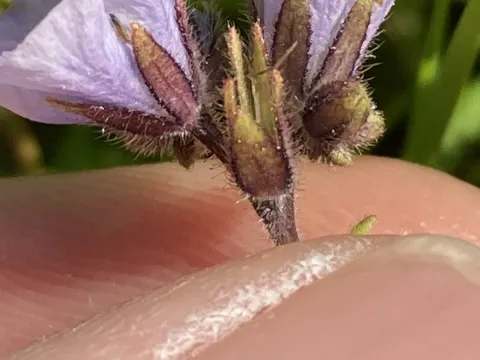
Fringed Phacelia
Phacelia ciliata
Fringed Phacelia is an annual herb of the Boraginaceae family. Sowing is typically performed in early spring as soon as the soil can be worked, which is crucial for early root establishment and moisture utilization.
What the section contains
Fringed Phacelia
Fall sowing is also feasible in regions with temperate climates, allowing for early spring growth and faster coverage. Given the very small seed size, shallow sowing at a depth of 1–2 centimeters is essential for proper germination.
The recommended seeding rate ranges from 8 to 12 kilograms per hectare, depending on local soil conditions and the intended use of the crop as either a green manure or a pollinator attractant.
When used as a cover crop, timing is critical to ensure that biomass incorporation occurs before the plants enter the advanced flowering stage, maximizing nutrient retention in the soil.
For beekeeping purposes, sowing dates are adjusted to align the peak flowering period with the primary nectar flow in the area, ensuring maximum utility for honey bees.
Native to Western North America, this species is highly adapted to arid conditions but requires adequate moisture during the initial growth phases to reach its maximum biomass potential.
Fringed Phacelia thrives in various soil types, particularly light, well-draining sandy or loamy soils. It demonstrates a remarkable tolerance for low-nutrient environments and slightly saline soils.
The plant is relatively cold-hardy, capable of surviving light spring frosts that are common during the early stages of the growing season in many agricultural regions.
Being a sun-loving plant, it requires full exposure to sunlight. Shaded environments or planting under dense canopy significantly reduces both vegetative growth and the intensity of floral nectar production.
The crop does not require intensive fertilization, as it is efficient at scavenging nutrients from the soil, making it a sustainable choice for organic and low-input farming systems.
The biological yield of Fringed Phacelia is impressive, with biomass production reaching 20–30 tons per hectare under optimal moisture conditions, effectively improving soil organic matter.
As a nectar-producing crop, it is highly valued by apiarists. Under favorable weather conditions, it can yield between 200 and 300 kilograms of honey per hectare during the peak bloom period.
Seed production yields generally fall between 0.5 and 1 centner per hectare. Successful seed development relies heavily on the presence of pollinating insects to ensure cross-pollination.
Productivity is highly correlated with planting density and soil moisture management. Proper spacing prevents intra-species competition while allowing for maximum development of side branches.
Beyond direct economic output, the crop serves as an effective soil conditioner, significantly enhancing soil structure, porosity, and hydraulic conductivity for subsequent cash crops.
Fringed Phacelia is known for its excellent phytosanitary profile. It is resistant to many common pathogens that affect cereal and cruciferous crops, making it a safe choice in diverse crop rotations.
Occasional root rot issues may arise in poorly drained fields or during prolonged periods of excessive waterlogging, which can be mitigated by careful field site selection and drainage management.
Pests such as aphids may infest young flower buds under stressed conditions. However, natural predators are often abundant in fields with high floral diversity, providing effective biological control.
Young seedlings can be susceptible to flea beetles in dry, warm springs. Maintaining optimal seeding rates and supporting healthy early growth is the best defense against such outbreaks.
The crop's rapid growth cycle usually allows it to outcompete most common weeds, significantly reducing the need for chemical herbicide interventions throughout the season.
Harvesting for green manure should occur during the full bloom phase, when the plant has maximized its nutrient content and before it begins to allocate energy toward seed maturation.
Seed harvest requires precision, as the pods can dehisce easily when over-dried. Harvesting must be timed accurately to minimize losses during the mechanical threshing process.
When used for soil improvement, the plant is typically shredded or mowed and incorporated into the top 10–15 centimeters of soil to facilitate efficient decomposition and carbon sequestration.
In honey production systems, the crop is left standing throughout the flowering period to provide continuous forage, with post-bloom biomass managed as organic soil fertilizer.
The deep, fibrous root system remains in the ground after harvest, contributing to long-term soil structure improvements and increasing the overall resilience of the farming ecosystem.