
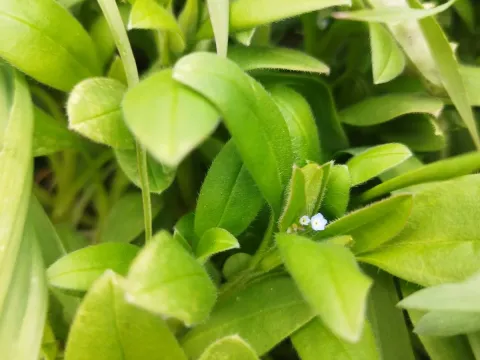
Sparse-flowered forget-me-not
Myosotis sparsiflora
The sparse-flowered forget-me-not (Myosotis sparsiflora) is an annual herb belonging to the Boraginaceae family. It is primarily recognized as a wild plant that occasionally occurs in agricultural landscapes, favoring moist and shady environments.
What the section contains
Sparse-flowered forget-me-not
Originating from temperate regions, the species is commonly found in floodplain forests, along stream banks, and in shaded meadows. Its presence in agricultural fields is often restricted to damp, low-lying areas with rich soil composition.
Botanically, it features branched stems reaching up to 40 cm in height, with characteristic lanceolate leaves. The light blue flowers are arranged in loose racemes, which are fewer in number compared to other members of the genus, hence the specific name.
The plant requires consistent soil moisture and moderate temperatures for optimal development. It is rarely found in drought-prone or heavily compacted soil environments, as its root system lacks deep penetration capability.
In terms of agricultural significance, while not a cultivated crop, understanding its biology helps in assessing the moisture levels and drainage conditions of the land, as it serves as a natural indicator of damp sites.
The primary threats to Myosotis sparsiflora include mechanical soil cultivation, which disrupts the seed bank and prevents the establishment of the plant within a managed crop cycle.
Pathogenic fungi, especially powdery mildew, represent a significant risk to the plant's health during seasons with high humidity and limited air circulation, leading to tissue necrosis.
Insects such as aphids and leaf-mining larvae can infest the foliage, reducing the plant's photosynthetic efficiency and overall vigor during the vegetative phase.
Competition from robust, fast-growing weeds like couch grass or thistles significantly hampers the growth of the sparse-flowered forget-me-not, often causing it to disappear from the local flora.
Effective management involves the implementation of integrated pest and weed control strategies, including crop rotation and the maintenance of optimal soil drainage, which keeps the population in check.