
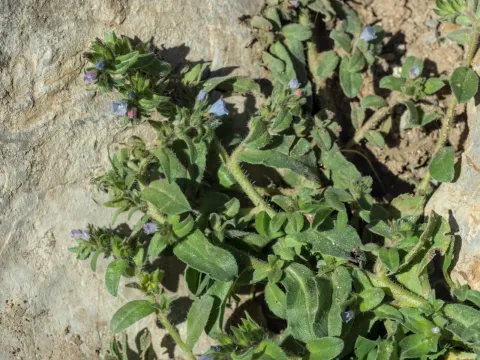
Small-flowered viper's bugloss
Echium parviflorum
The small-flowered viper's bugloss (Echium parviflorum) belongs to the Boraginaceae family. This annual herb is typically sown in early spring as soon as the soil warms up to at least 5–8 degrees Celsius.
What the section contains
Small-flowered viper's bugloss
The optimal sowing period ranges from early April to mid-May, depending on the specific climate zone. The plant exhibits high germination energy provided there is sufficient soil moisture following the winter period.
A row-seeding method is standard, with row spacing between 30 and 45 centimeters. Seeds should be sown at a shallow depth of 1–2 centimeters to ensure even seedling emergence and prevent competition for light.
Given the small size of the seeds, the seedbed must be well-prepared and compacted. Post-sowing rolling is a crucial agricultural practice that ensures the seeds maintain optimal contact with the soil for successful germination.
The seeding rate varies from 4 to 6 kilograms per hectare. The crop is known for its rapid initial growth, which allows it to form a dense canopy that effectively suppresses weed development in the field.
This crop is highly undemanding and adapts exceptionally well to dry Mediterranean climates. It thrives in sunny, open areas and does not tolerate shading or excessive water saturation in the root zone.
It has minimal soil requirements, growing successfully in stony, sandy, or carbonate soils with a neutral or slightly alkaline pH. Heavy clay soils with poor drainage are considered unsuitable for this species.
Small-flowered viper's bugloss possesses a strong taproot system that penetrates deep into the soil horizons. This adaptation provides the plant with superior drought resistance, allowing it to vegetate during periods of moisture stress.
The temperature range for optimal development is between 20 and 28 degrees Celsius. Despite its southern origins, the plant can withstand occasional light spring frosts without suffering significant damage.
Agricultural management includes regular cultivation between rows during the early stages of growth to improve aeration and moisture conservation in the root zone, which is vital for forming a healthy stand.
The primary economic value of the crop is its outstanding potential as a honey plant. It is widely recognized for producing high-quality nectar, even under adverse weather conditions during the summer season.
Under favorable conditions, honey production from mass plantings can reach 150 to 300 kilograms per hectare. The resulting honey is known for its light color and pleasant sensory properties.
The crop is sometimes utilized as a green manure to improve soil structure and organic matter content. Its ability to stabilize soil makes it useful for erosion control on sloping agricultural lands.
Its nutritional value as fodder is limited due to the presence of coarse trichomes (hairs) on the leaves and stems, which can irritate livestock. Consequently, it is rarely used as a primary source of forage.
Seed yield is significantly dependent on pollinator activity. Placing bee colonies near the field during the flowering period can increase seed output by 20–30 percent through improved fertilization.
The small-flowered viper's bugloss is highly resistant to most common agricultural diseases. Serious outbreaks that would threaten the viability of the crop are rarely observed in commercial production.
In cases of excessive humidity and high planting density, occurrences of powdery mildew or root rot are possible. Adhering to recommended seeding rates and crop rotation practices prevents these issues.
Pests cause minimal damage to the crop. While certain leaf beetles may occasionally graze on the foliage, such incidents rarely reach the economic injury level, making chemical intervention unnecessary.
The plant produces alkaloids as a natural defense mechanism against herbivores. This chemical composition serves as an effective biological barrier, reducing losses from insect damage throughout the season.
If pest control becomes necessary, biological treatments are preferred over synthetic pesticides. This protects the local bee population, which is essential for ensuring successful pollination and seed production.
Harvesting the seeds requires precision because the fruit ripens unevenly. The onset of the harvest should be triggered when the lower parts of the inflorescences turn brown and the seeds reach a deep dark color.
A two-stage harvesting method is recommended. The plants are mowed into windrows and left to dry for several days, which allows for uniform maturation and results in a higher-quality seed batch.
Direct combining is generally avoided because it leads to significant losses due to seed shattering if the crop is not harvested at the exact moment of peak maturity.
Once harvested, seeds must be cleaned of plant debris and dried thoroughly. Storage should take place in dry, well-ventilated facilities with a relative humidity maintained below 60 percent.
Properly dried and stored seeds maintain their germination capacity for 3 to 4 years. Regular monitoring of storage conditions is required to prevent moisture-related quality loss.