
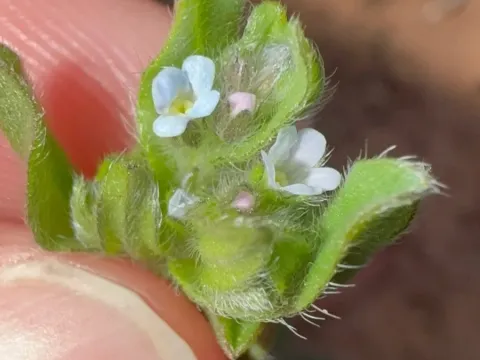
Stickseed
Lappula
Stickseed (Lappula) is an annual herbaceous plant that reproduces primarily through seeds in natural conditions. Germination begins in early spring when soil temperatures reach 4–6 degrees Celsius.
What the section contains

Stickseed
Mass emergence occurs upon the arrival of stable warm weather, allowing the plant to rapidly colonize open spaces in fields and pastures.
In agricultural practice, stickseed is considered a difficult weed to eradicate, as its seeds maintain high viability in the soil for several years.
Controlling emergence requires timely harrowing during the early development stages, while the seedlings have not yet established a deep root system.
The germination characteristics of stickseed allow seeds to emerge from depths of up to 5–6 centimeters, complicating control efforts under reduced tillage practices.
Plants of the genus Lappula belong to the Boraginaceae family and are characterized by high ecological plasticity, enabling them to thrive in diverse climatic zones.
Moderately dry soils are the most favorable for development, although stickseed adapts excellently to saline, sandy, and loamy soil types.
The plant prefers well-lit areas, which is why it is frequently found in open fields, fallow land, along roadsides, and on degraded pastures where competition is minimal.
Stickseed possesses a strong taproot, allowing it to efficiently utilize moisture from deeper soil horizons during drought periods.
The optimal soil pH level for the successful development of this species ranges from neutral to slightly alkaline, explaining its widespread distribution across steppe and forest-steppe regions.
The primary harmful factor of stickseed is its ability to actively compete with crops for nutrients, water, and available space.
As a member of the Boraginaceae family, the plant can act as a reservoir for certain viruses and phytoplasmal diseases that affect cereal and vegetable crops.
Stickseed is rarely affected by specific diseases in the wild, as its surface is covered with dense, rigid trichomes that create a physical protective barrier.
The main threat to agronomists is the contamination of seed stocks, as stickseed seeds have hooked appendages that easily attach to animal fur and clothing.
Effective control methods include crop rotation, deep plowing, and the application of selective herbicides during the active growth phase of the primary crop.